
What Does “North-East Facing” Actually Mean?
Most people think a house is north-east facing if it sits on the north-east side of a street, or if someone pointed at it and said so. That is not how Vastu defines it.
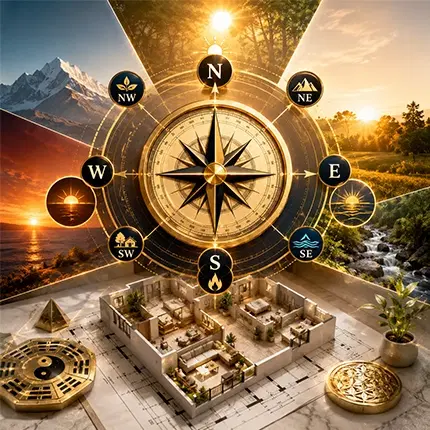
A house is north-east facing when you step out through the main entrance and find yourself looking in the north-east direction, roughly 22.5° to 67.5° on a compass. The front of the house, by that definition, is the face it shows the north-east. Everything follows from that.
This distinction matters because real estate listings routinely mislabel direction. Before any Vastu assessment can begin, the actual compass reading at the entrance is the starting point not the plot’s map position, not the road it faces.
Why the North-East Holds Its Reputation in Classical Vastu ?
The Ishanya corner is not considered auspicious by convention. The reasoning in classical texts is structural.
Earth’s magnetic field runs south-to-north. Solar energy enters from the east every morning. The north-east corner sits at the point where these two forces intersect. The Manasara, one of the foundational Vastu texts, classifies this zone as particularly receptive to both influences simultaneously. The Mayamata reinforces this by designating the north-east as the Devagriha: the direction of the divine, appropriate for shrines, water sources, and meditation spaces.
The deity association matters too. The Ishanya corner is ruled by Lord Shiva in Sanatan cosmology, the presiding force of transformation, clarity, and dissolution of obstacles. Vastu design that honours this zone is, in this tradition, aligning with that energy rather than blocking it.
Practically, there is also an environmental logic. A north-east facing home in India’s climate receives morning sunlight directly into the front of the house. Morning sun, before 10 AM, is low-intensity, health-supporting, and naturally warming without producing the afternoon heat that west-facing rooms bear. Homes that capture morning light from the north-east tend to feel brighter and less thermally heavy through the day.
The Pada System: Where Your Main Door Actually Placed
Popular Vastu writing says: “put your main door in the north or east for a north-east facing house.” That advice is accurate in broad strokes but misses the precision that classical Vastu actually uses.
The north-east wall of any property is divided into eight equal sections, called padas. Each pada carries a name, a ruling deity, and a specific energy signature. Placing the main door in the wrong pada of an otherwise auspicious north-east wall can introduce the very problems homeowners were hoping to avoid.
| Pada | Name | Approx. Range | Vastu Quality |
| 1st | Shikhi | 22.5°–30° | Auspicious clarity and mental peace |
| 2nd | Parjanya | 30°–37.5° | Auspicious abundance and rain-energy |
| 3rd | Jayanta | 37.5°–45° | Highly auspicious growth and prosperity |
| 4th | Indra | 45°–52.5° | Good strength and authority |
| 5th | Surya | 52.5°–60° | Moderate active energy, watch heat |
| 6th | Satya | 60°–65° | Neutral proceed with care |
| 7th | Bhrisha | 65°–67.5° | Avoid linked with dispute energy |
| 8th | Antariksha | At boundary | Avoid transitional, unstable |
The third pada, Jayanta, is considered the sweet spot for a north-east facing entrance. It aligns with Jupiter’s energy in Vedic cosmology the planet most associated with growth, wisdom, and dharmic wealth.
A qualified Vastu assessment will use a compass at the entrance, not estimate from a floor plan.
Room-by-Room Guide for a North-East Facing House
Getting the direction right sets the stage. Getting the internal layout right is the performance.
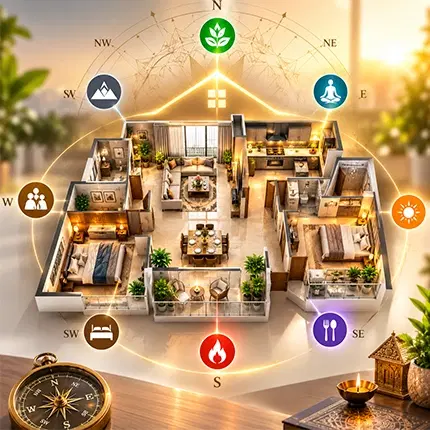
Entrance and Living Room- The Vastu tips for living space in a north-east facing house works best when positioned in the north or north-east zone of the floor plan. Seating arrangements should allow occupants to face east or north, toward the incoming energy, rather than having their backs to it. Keep this area uncluttered. The north-east is a receiving zone; blocking it with heavy storage, dark furniture, or structural features disrupts the energy flow the direction is supposed to bring in.
Pooja Room or Meditation Space- The north-east corner is the classical recommendation for a pooja room, and there is no disagreement across texts here. The Devagriha designation makes this the most appropriate zone for shrines, idols, and prayer spaces. If the floor plan cannot accommodate a dedicated pooja room in the north-east, a north or east corner is the next-best placement.
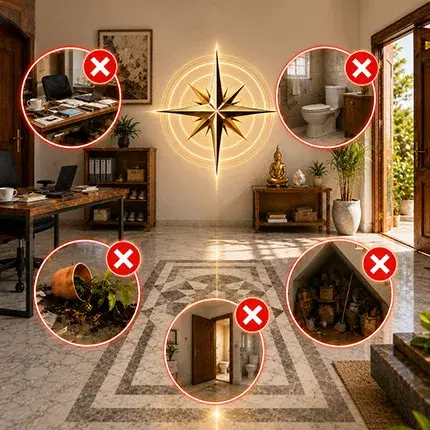
Bedrooms- This is where most north-east facing homes go wrong. The north-east corner is not suitable for the master bedroom. The energy here is active, spiritually charged, and associated with water, qualities that create mental restlessness rather than rest when you sleep in them regularly.
The master bedroom belongs in the south-west. Always. Classical Vastu treats the south-west as the zone of stability and earth energy, the heaviest corner, appropriate for the most important and restorative function in the home. If a multi-floor property is involved, the topmost south-west room is the recommended position for the master bedroom.
Other bedrooms can occupy south, west, or north-west positions. Children’s rooms work well in the west or north-west.
Kitchen- The kitchen must not be in the north-east. This is one of the non-negotiable rules in classical Vastu, and it appears consistently across Manasara, Mayamata, and Vishwakarma Prakash.
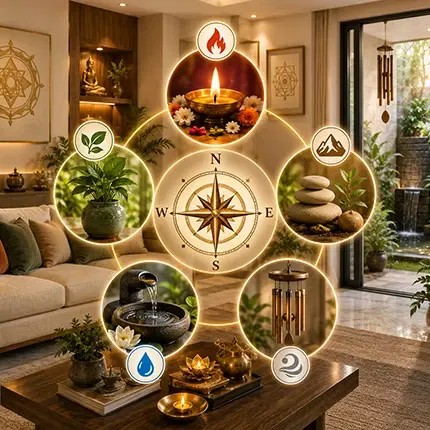
Fire and water are opposing elements. The north-east is the water-element zone. Placing a kitchen, which is the fire zone (Agni Kona), here creates elemental conflict that Vastu tips for health issues, family disputes, and financial instability.
The correct placement: south-east (Agni Kona, the fire corner) is ideal. North-west is acceptable. The cook should face east while cooking.
If your kitchen is already in the north-east: position the stove in the south-east corner of that kitchen space, face east while cooking, and keep the north-east portion of the kitchen as a water or storage area. This is a partial remedy, not an equivalent replacement.
Bathrooms and Toilets- The north-east corner should never house a toilet. This is perhaps the most commonly violated rule in urban apartments, where builders prioritise space efficiency over orientation. Appropriate zones for bathrooms: south, south-east (for attached bathrooms to the master bedroom), and north-west. West is also acceptable. Always keep bathroom doors closed.
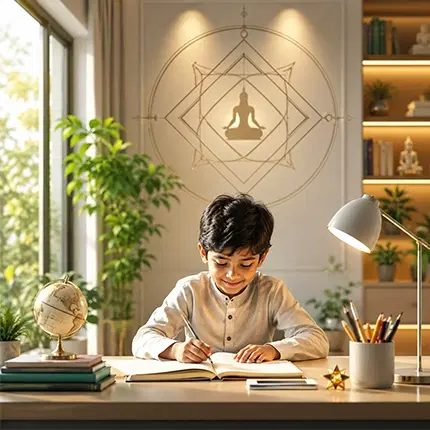
Study Room- The north-east, north, or east zones are excellent for a study room or children’s study area. These are zones of clarity and incoming light practical and Vastu-aligned simultaneously. The student should ideally face east or north while studying.
Staircase- Never place a staircase in the north-east. Classical texts and modern Vastu practitioners both identify this placement as a significant source of neurological stress and mental clarity issues among occupants. South-west, south, or west are the preferred zones for staircases in a north-east facing home.
Vastu for the Plot Itself: External Factors That Affect the Result
The house does not stand alone. The plot is placed on carries its own Vastu signature, and a north-east facing property can be fully supported or actively undermined by plot-level factors.
Plot Shape and Ratio- The ideal ratio for a north-east facing plot is 1:2 (width to length). Plots that are wider at the front and narrower at the back are considered auspicious for this facing. Irregular shapes, T-intersections, or plots where the north-east corner is cut or truncated require specific remedies.
Plot Slope- The slope must run downward toward the north-east. A plot that slopes south or west while facing north-east creates a structural contradiction. Ground-level water accumulation in the south-west corner is considered the worst possible Vastu condition for financial stability.
Compound Wall and Open Space- Keep the compound wall lower on the north and east sides, and taller on the south and west. Maintain maximum open space in the north-east. Do not plant large trees in the north or east, they block incoming solar and magnetic energy. Small plants and ground cover are fine.
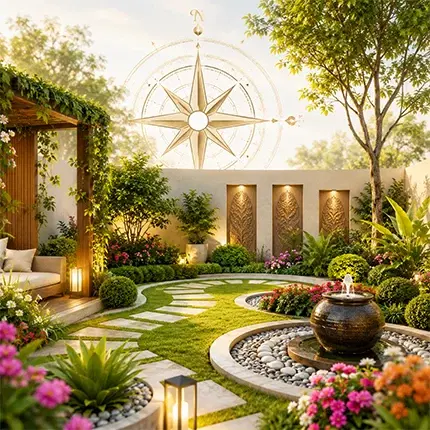
Water Body Placement- A water body, a small fountain, tank, or indoor water feature, in the north-east amplifies the energy of this zone. The north-east is the water element corner. Supporting it with an actual water feature is one of the most straightforward positive interventions available for this property type.
What a North-East Facing House Cannot Fix?
A good facing is a starting advantage, not an automatic outcome.
Many buyers chase north-east facing properties based on the direction alone, then live in homes where the kitchen is in the north-east corner, the master bedroom sits where the pooja room should be, and the toilet opens directly toward the front of the house. The orientation brought them the house. The internal layout determines what that house delivers.
Vastu for a north-east facing home is a complete system: plot orientation, slope, compound layout, room placement, door padas, furniture positioning, and elemental balance all function together. When one critical element is wrong, especially kitchen or toilet in the north-east, the directional benefit is not reduced, it is inverted.
What We See in Consultations: The Most Misunderstood North-East Property
In our practice at LayeredVastu, north-east facing properties come to us in two conditions: either the clients are delighted with their home’s energy and want to understand why it works so well, or they are baffled they bought the “best direction” property and something has been consistently off since they moved in.
Almost every time the second situation occurs, we find one of three things: a kitchen in the north-east corner, a toilet opening toward the north or east, or a master bedroom positioned in the north-east zone. The direction gave the house its potential. One of these placements removed it.
A family in South Delhi came to us after two years of persistent financial stress in a property they had specifically bought for its north-east facing. On assessment, the kitchen occupied the entire north-east corner, an apartment layout that the builder had treated as standard. The conflict between the fire element of the kitchen and the water-element zone it occupied was textbook. We recommended repositioning the gas burner to the south-east corner of that kitchen, placing a water element in the north-east portion of the kitchen space, and using cream and white tones throughout, all non-structural corrections. The clients reported a measurable shift in household stability within three months.
The north-east is not a guarantee. It is an invitation.
The Ishanya corner is the most sensitive zone in any property. When it is clean, open, and aligned, it amplifies everything positive. When it carries the wrong element fire, waste, or structural obstruction it becomes the most damaging zone instead. The direction does not decide the outcome. What you place there does.” — Seema Bhatia, Vastu Consultant, LayeredVastu
Key Takeaways
The north-east orientation gives your home a structural advantage that few other directions match. Whether it delivers on that advantage depends on what comes next.
The north-east corner (Ishanya) is classified in the Manasara and Mayamata as the water-element zone and the Devagriha, position your pooja room, study, or water feature here.
Main door placement must follow the pada system, the Jayanta pada (3rd) is the most auspicious position; avoid the 7th and 8th padas entirely.
Kitchen, toilet, and staircase in the north-east are the three placements that negate the directional benefit, correct these before any other Vastu intervention.
The master bedroom belongs in the south-west , not the north-east, regardless of how the house faces.
A plot with a north-east downward slope amplifies the benefit of this orientation; a south-west slope undermines it even if the facing is correct.
If your north-east facing home is not delivering the clarity, stability, and wellbeing this direction is known for, the answer is almost always in the internal layout, not the direction.
FAQ
Frequently Asked Questions
A north-east facing house is considered the most auspicious direction in Vastu Shastra, governed by the Ishanya corner associated with water, divinity, and clarity. However, the direction alone does not guarantee positive outcomes. Internal room placement, particularly keeping the kitchen, toilet, and staircase away from the north-east, determines whether the directional benefit actually manifests in daily life.
Classical texts including the Manasara and Mayamata classify the north-east as the Devagriha, the abode of the divine and prescribe it specifically for prayer rooms and water sources. The Brihat Samhita references the Ishanya direction as the receiving point of geomagnetic and solar energy. Placing a shrine or water element here is a classical injunction, not a modern interpretation.
The main door in a north-east facing house should fall in the third pada (Jayanta), which spans approximately 37.5°–45° on the compass wall. The first (Shikhi) and second (Parjanya) padas are also auspicious. The seventh and eighth padas near the boundary between north-east and east , should be avoided. A compass reading at the entrance is required to identify the correct pada.
The three most damaging errors are placing the kitchen in the north-east corner (fire element conflicts with water zone), building a toilet that opens toward the north or north-east, and positioning the master bedroom in the north-east. These mistakes are frequently found in standard urban apartment layouts. Each carries specific remedies, but non-structural corrections only partially address the elemental imbalance.
The pooja room, meditation space, and study room are the most appropriate placements for the north-east zone. These functions benefit from the clarity, spiritual charge, and incoming morning light that the north-east naturally provides. The living room entrance can also face north-east. Heavy furniture, large storage units, and service areas should be kept out of this zone entirely.
North-east facing properties are considered particularly beneficial for Meen (Pisces), Karka (Cancer), and Vrishchika (Scorpio), the water-sign rashis that naturally align with the water element governing this direction. For other rashis, a north-east facing house can still be beneficial if the internal layout is correct. Individual astrological compatibility is best assessed alongside Vastu, not as a standalone deciding factor.
The plot should slope downward toward the north-east. This allows both rainwater and symbolic energy to collect in the most auspicious zone. A plot that slopes toward the south or west even if it faces north-east creates a contradiction that neutralises the directional benefit. Elevated ground in the south-west combined with a lower north-east is the classical Vastu ideal.
Partial correction is possible without demolition. Reposition the gas burner to the south-east corner of that kitchen space and ensure the cook faces east. Place a water element, a small bowl or a plant that requires frequent watering, in the north-east portion of the kitchen. Use white or cream tones. These remedies reduce elemental conflict but do not fully replicate correct original placement.
A professional assessment is worth commissioning at three specific points: before purchasing a property where you cannot verify compass-based facing and pada, during a renovation where room functions are changing, or when a correctly oriented home is not producing the expected stability or wellbeing over time. On-ground compass assessment is more reliable than floor-plan-only analysis, which misses slope and actual door positioning.
The same principles apply, but apartments have fewer correction options, you cannot alter the compound wall, external slope, or shared structure. The focus for apartments shifts to internal zone management: keeping the north-east corner clean and open, placing the pooja or study there, and addressing service areas through colour, element placement, and door management. The individual flat’s facing takes precedence over the building’s facing.
Related Posts






Ready to Transform Your Space?
Get expert Vastu guidance from Seema Bhatia. Start your journey to harmony and prosperity today.