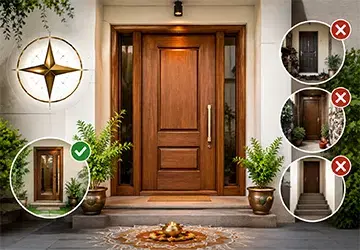
Vastu For Doors
Place in the suited direction
12+
Years of Experience
3000+
Satisfied Clients
5+
International Presence
99%
Success Rate
100%
Authenticity And Transparency
Highlights
Door Vastu - Direction & Placement
Based on 58 Google Reviews
Main Door Direction and Placement
Avoid South-West EntranceDoor Size and Proportion
Main Door Should Be Large In SizeMaterial and Decoration
Decorate The Main Door With Icons Of Prosperity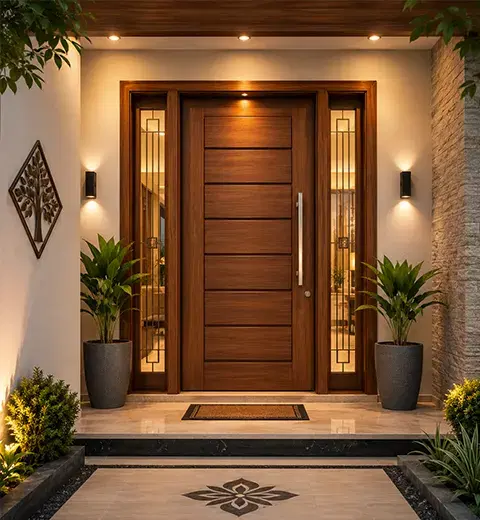
About
About Vastu For Doors
In Vastu Shastra, the main door is called the Simhadwar, the lion's gate. It is treated as the mouth of the home, the single point through which people, opportunities, and prana (life force) are believed to enter. Get the entrance right and the rest of the house tends to fall into place. Get it wrong and even a beautifully designed home can feel heavy.
This guide is written for real homeowners, especially anyone living in a builder flat where you cannot move the door. It covers everything worth knowing, and unlike most articles it answers the two questions people actually type into search but rarely find answered: how do I fix a bad door without demolition, and what will it honestly cost me?
A quick, honest note: Vastu Shastra is a traditional Indian system of architecture and spatial design, thousands of years old. Its remedies are cultural and faith-based rather than scientifically proven. This guide explains what Vastu recommends and what it costs, so you can make an informed choice for your own home.
Every other Vastu decision in your home is secondary to the entrance. The reasoning is simple: the door is the filter. It decides the quality and quantity of energy entering the space, which is why classical texts describe Lakshmi (prosperity) as entering through a well-placed, well-kept doorway.
Practically, this also has a grounded logic. An east or north-east door catches gentle morning light, which is energetically auspicious and hygienically better for ventilation and mood. A clean, bright, welcoming threshold genuinely changes how you feel walking in after a long day. So even a sceptic gets value from most of these tips.
The whole point of getting the entrance right is the people inside. In Vastu, the main door is believed to shape the fortunes of everyone who lives or works behind it, and the effect is thought to fall differently on different people. Here is how it is traditionally understood to play out, first for a home, then for an office.
At Home: Impact on Family Members
- Head of the family and main earning member: The entrance is tied to authority, income, and big decisions. A well-placed door is believed to support the breadwinner's career and financial stability, while a South-West or defective door is linked to stress, disputes, and money that never seems to stay.
- Women of the house: A South-East (Agni) entrance is traditionally associated with tension, health troubles, and frequent conflict for the women of the home. A balanced entrance is said to support their health and peace of mind.
- Children: North, North-East, and East doors are considered the best for children, and are linked to stronger concentration, studies, health, and a clear, calm mind.
- Elderly parents: A clean, bright, and well-maintained entrance is associated with better health and calm for older members. A dark, cracked, or creaking door is believed to drain their vitality.
- Harmony between members: A door that opens anti-clockwise or sits in the wrong pada is linked to delays, misunderstandings, and constant differences of opinion. A main door that lines up straight with the back door is believed to let money and harmony flow right out, which affects everyone's savings.
- Guests and the family's reputation: The entrance sets the first impression. A welcoming, well-lit door is believed to attract goodwill, warm relationships, and social standing for the whole household.
At an Office: Impact on the Team
- Owner or boss: The entrance is tied to the leader's clarity, authority, and the direction the business takes. A South-West or defective door is linked to instability and poor decisions at the top.
- Employees and staff: A bright, spacious, welcoming entrance is associated with focus, higher morale, and fewer conflicts among the team. A dark or cramped entry is believed to cause friction and low energy.
- Cash flow and finances: A door that aligns with the back exit, or faces a fast-moving staircase or lift, is believed to let revenue and hard work slip away, which affects salaries, bonuses, and growth.
- Clients and footfall: The entrance is thought to govern the flow of customers and opportunities. A clean, prominent door invites more business, while an obstructed or hidden one blocks it.
- Reputation and partnerships: A cracked, creaking, or cluttered entrance is linked to a weak market image and strained business relationships.
- Overall business growth: North, East, and North-East entrances are considered the most favourable for expansion, steady income, and long-term stability.
The direction your door faces (stand inside, look out) is the first thing any Vastu check looks at. Here is the honest verdict, direction by direction.
| Direction | Vastu verdict | Believed to bring | Notes |
| North-East (Ishan) | Most auspicious | Clarity, peace, spiritual growth | The "divine corner", the gold standard |
| North (Kuber) | Excellent | Wealth, career, stability | Keep it clutter-free and well-lit |
| East (Indra) | Excellent | Health, growth, new beginnings | Morning sun; great for families |
| West | Neutral to good | Stability, gains through effort | Perfectly workable |
| South-East (Agni) | Mixed | Conflict or money stress if uncorrected | Fire zone; usually needs a remedy |
| South (Yama) | Mixed (misunderstood) | Depends on the exact spot | Not automatically bad; see myth |
| South-West (Nairutya) | Least favourable | Instability, disputes | Remedies considered essential |
The nuance almost no guide tells you: padas
Direction alone is not the full picture. Vastu divides each direction into energy bands called padas (steps). There are 32 around the building's perimeter. A door in the right direction but the wrong pada can behave worse than a correctly placed door in a bad direction.
This matters because a shift of just 5 to 10 degrees on the compass can move your door from an auspicious pada to an inauspicious one. Two takeaways:
- A "north-facing building" does not mean the main door faces north. Measure the door independently.
- Eyeball estimates fail. Use a compass app and read the door's facing directly.
This single point, padas rather than just directions, is the biggest content gap between generic Vastu articles and an actual expert consultation.
Vastu for the main door has not changed in principle, but how people apply it has changed enormously, especially now that most Indians live in fixed builder flats rather than self-built homes. Here is the shift.
| Aspect | Traditional approach (older homes) | Modern approach (2026 |
| Door placement | Home was built around the ideal entrance pada | Door is fixed by the builder; you work with what you have |
| Fixing a bad door | Fixing a bad door Rebuild or relocate the wall |
Non-demolition remedies (strips, pyramids, colour, light) |
| Finding direction | Priest or astrologer with a physical compass | Smartphone compass apps plus online floor-plan analysis |
| The door itself | Heavy solid teak, carved chaukhat (threshold) | Teak or engineered wood plus smart locks, video doorbell |
| Symbols | Fresh mango-leaf toran, hand-drawn swastik | Brass or fabric torans, engraved Om or Swastik panels |
| Consultation | In-person visit only, word of mouth | Online consultation over video; plan shared on WhatsApp |
| Mindset | Rules followed strictly, often out of fear | Blended with interior design; harmony over superstition |
The headline change: you no longer need to break walls. The entire modern remedy industry exists to correct entrance dosha (defects) without touching the structure. A carved teak door with a smart lock and a small Om panel is exactly what a 2026 Indian home looks like when tradition and technology meet.
If you do nothing else, do these. Most take a weekend and cost under Rs 1,000 combined.
- Declutter the threshold. Remove shoe racks, dustbins, brooms, dead plants, and old newspapers. The single highest-impact free fix.
- Add light. A dark entrance is said to stagnate energy regardless of direction. Fit a warm-white bulb above the door.
- Oil the hinges. A creaking door is called an energy leak, and it is just plain irritating. Fix it.
- Check the swing. The door should open inward and clockwise (swinging to your right as you enter).
- Make it the boss door. The main door should be the tallest and widest door in the house.
- Hang a toran. Fresh mango leaves or marigold, believed to filter positive energy in and negative energy out.
- Fix a nameplate on the right side of the frame, associated with recognition and directing energy inward.
- Clear the view. No mirror should face the main door (believed to bounce energy back out). Avoid a bare wall in front too.
Can't change the direction? You almost never can in a flat, and Vastu has always allowed for remedies. Here are the common corrective tools and what each one addresses.
- Copper or brass threshold (chaukhat): symbolically blocks negative energy at the entry line.
- Copper pyramid arrows: the standard fix for a door that opens anti-clockwise, fixed in sets of three per door.
- Copper metal strip or pyramid divider: classic remedy for a wrongly placed or south-west door, used in multiples of three.
- Copper Swastik pyramid above the door: for an inauspicious placement, a facing staircase or lift, or a tree or pole in front.
- Vastu pyramid or zinc helix: placed near the entrance to rebalance a non-ideal direction.
- Direction-based colour on the door: the cheapest structural-feeling change.
- Ganesha idol above the door, facing outward, at or above eye level: the most recommended entrance symbol.
South or south-west door? Layer the remedies: warm earthy colour, a copper element, a Swastik or Ganesha, and strong lighting. Two doors facing each other? Draw a swastik in red kumkum, or use a toran or partition to soften the clash.
This is the section most guides skip entirely. Prices are typical India-wide ranges as of 2026 and vary by city, material, and brand.
Remedies & products (DIY)
| Fix / product | Typical cost (Rs) |
| Fresh or fabric toran (mango leaf, marigold, beaded) | 50 to 500 |
| Warm LED light above door | 200 to 1,500 |
| Wooden or brass nameplate | 300 to 3,000 |
| Brass Ganesha idol or Shubh-Labh plaques | 200 to 1,500 |
| Copper Swastik pyramid (above door) | 400 to 1,100 |
| Copper pyramid arrows (anti-clockwise fix, set of 3) | 440 to 600 |
| Copper strip or pyramid divider (set of 3) | 490 to 850 |
| Vastu pyramid or zinc helix | 500 to 2,500 |
| Marble or wooden threshold (chaukhat) | 500 to 5,000 |
| Repainting the door an auspicious colour (DIY vs painter) | 500 to 3,000 |
Reality check: a solid, meaningful entrance correction using symbols, colour, light, and copper remedies usually lands between Rs 1,500 and Rs 6,000 total, with no demolition needed.
Professional consultation
| Service | Typical cost (Rs) |
| Basic online consultation (1BHK or 1RK) | 1,500 to 5,000 |
| Standard residential (3 to 4 BHK) | 5,000 to 15,000 |
| On-site home visit (metros) | 4,200 to 7,500+ |
| Mid-level detailed analysis | 15,000 to 50,000 |
| Premium or celebrity consultant | 50,000 to 2,00,000+ |
| Per-square-foot models (flat or home) | about Rs 15 to Rs 50 per sq ft |
If you genuinely relocate or replace the door (structural)
Carpentry plus civil work to move or install a new main door typically runs Rs 15,000 to Rs 1,00,000+ depending on size, material, wall work, and finish. This is a last resort. Remedies exist precisely so you don't have to.
Money-saving tip: A good consultant recommends only what you need, and product recommendations should be separate from the fee. If someone insists you must buy expensive items from them specifically, treat it as a red flag.
Do
- Keep the entrance clean, bright, and welcoming at all times.
- Make the main door the largest in the home; ensure it opens inward, clockwise.
- Install a threshold, a nameplate, and a toran.
- Place Ganesha above the door facing outward.
- Match the door colour to its direction (below).
Don't
- Face the door with a mirror, shoe rack, dustbin, broom, or dead plant.
- Let the door directly align with the back door (energy enters and exits straight through).
- Have it open onto a bedroom or bathroom door immediately.
- Position it facing a staircase, lift, or a T-junction road.
- Leave cracks, creaks, or peeling paint on it. An unwelcoming door is considered strongly inauspicious.
- Paint it black (believed to absorb and dampen energy).
Colour is the cheapest structural-feeling remedy. Match it to the direction the door faces.
| Door faces | Recommended colours |
| North | Green, blue, dark green |
| East | Light wood, white, pale yellow |
| West | White, silver, metallic tones |
| South | Warm earthy tones, terracotta, beige |
| South-East | Pale silver, light shades |
| Any / default | Natural teak wood is always safe |
Avoid black in every direction. Natural wood is the universal safe choice if you're unsure.
- "South-facing means unlucky." Largely a myth. South is mixed and depends on the exact pada; a correctly placed south door can outperform a badly placed north one.
- "A north-facing house is automatically good." No. A north entrance in the wrong pada can cause more trouble than a well-placed south door.
- "Just hang a mirror to fix it." Generic remedies don't address a structural defect, and a wrongly placed mirror at the entrance can make things worse.
- "A downward staircase in front is always bad." It is not universal; the effect depends on placement.
- "Remedies mean I must break walls." The entire point of modern Vastu remedies is that you don't.
- My builder fixed the door, am I stuck?" No. Flats are the norm; remedies exist exactly for fixed layouts.
- "Should the door open left or right?" There is no strict left or right rule, but it should open inward and clockwise.
- "Do smart locks and video doorbells break Vastu?" No. Modern hardware coexists fine with traditional elements.
- "Where exactly does Ganesha go?" Above the door, facing outward, at or above eye level, never on the floor.
- "Two flat doors facing each other, a problem?" A mild clash; soften it with a swastik, toran, or partition.
- "Do I need a consultant or can I DIY?" Direction, colour, symbols, and decluttering are safe to DIY. For pada-level analysis, a consultant earns their fee.
Vastu for doors comes down to one idea: the entrance sets the tone for the whole home, so treat it with care. You don't need to break walls or spend lakhs. Start with the free wins (declutter, light it well, fix the swing, add a toran and nameplate), then layer in direction-based colour and a copper remedy if your door faces a challenging direction. A meaningful, non-demolition correction typically costs between Rs 1,500 and Rs 6,000, and a professional opinion for a tricky layout starts around 1,500 to Rs 5,000 online.
Whether you follow Vastu as faith, tradition, or simply as a nudge toward a cleaner, brighter, more intentional entrance, the practical result is the same: a doorway that feels genuinely good to walk through. And that is an upgrade worth making this weekend.
Benefits
Benefits of Correct Door Vastu
Attracts Positive Energy
Escalates Harmonious Atmosphere
Increases Peace and Happiness
Paving Way For Growth
Vastu Tips
Important Tips & Points of Door Vastu
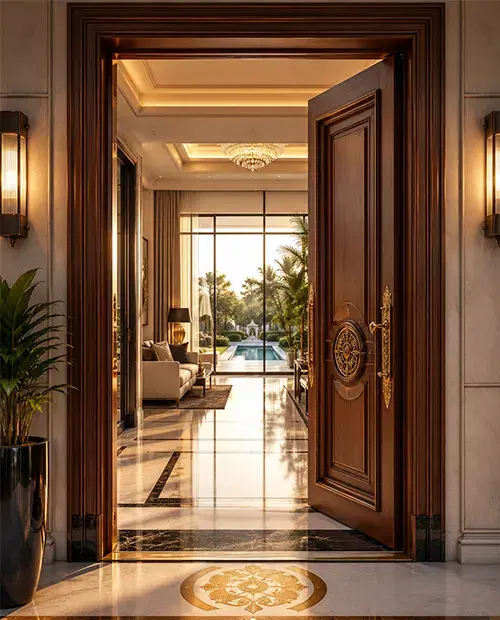
POINTS TO BE TAKEN UNDER CONSIDERATION
- Ideal Directions For The Main Door Of The House Should face North, East, or North-East.
- Avoid Having The Main Door In South-West Direction As It can bring financial instability.
- Well-Maintained Doors: Regularly clean, oil, and maintain the doors. Cracks, squeaks, or broken parts can disrupt positive energy.
- Secondary Doors At Your Residence Should Be Smaller Than the Main Door.
- Avoid Having Bedroom or Kitchen doors Facing The Entrance, As It Blocks Positive Energy.
Why Choose Us
Why Choose Layered Vastu for Door Vastu
100% Certified
Authentic Documents, Showcasing Legality100% Customer-Centric
Customization As Per Client's RequirementLifetime Assistance
Offering Services For The Entire LifespanFAQ
Vastu For Doors - People also ask
North-East is the most auspicious, followed by North and East. West is neutral to good. South and South-East are mixed and may need remedies; South-West is the least favourable.
Not automatically. It is a mixed direction that depends on the exact pada. The blanket fear around south-facing homes is overstated.
Yes. Copper strips, pyramids, a Swastik, direction-based colour, strong lighting, and symbols are all non-demolition remedies.
It depends on direction: green or blue for north, whites or light wood for east, white or silver for west, earthy tones for south. Avoid black. Natural teak is a safe default.
Basic online consultations run about ₹1,500 to ₹5,000, mid-level detailed analysis ₹15,000 to ₹50,000, and premium experts ₹50,000 and above.
Inward and clockwise. Outward or anti-clockwise opening is considered a defect, correctable with copper pyramid arrows.
Above the door, facing outward, at or above eye level. A brass Ganesha is most recommended.
Explore More
Similar Vastu Services
Vastu For Bedroom
Make it Vastu Compliant
Read More
Vastu For Main Home Entrance
Make an auspicious entrance
Read More
Vastu For Cross Ventilation
Let the fresh air enter your home
Read More
Vastu For Garage
Welcome goodness from the garage
Read More
Vastu For Toilets
Make your living healthy
Read More
Vastu For Villa
Get the beautiful and positive living
Read MoreReady to Transform Your Space?
Get expert Vastu guidance from Seema Bhatia. Start your journey to harmony and prosperity today.