Vastu For Griha Pravesh
Make an auspicious entry
12+
Years of Experience
3000+
Satisfied Clients
5+
International Presence
99%
Success Rate
100%
Authenticity And Transparency
Highlights
Griha Pravesh Vastu - Muhurat & Direction
Based on 56 Google Reviews
Permanent Joy To Lives
Introduction Of True HappinessProsperous Start
Progress In Professional and Personal LivesElude Negativity
Welcomes Positivity From All Sides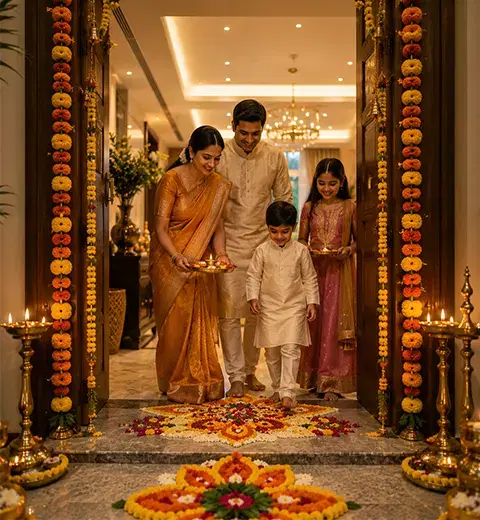
About
About Vastu For Griha Pravesh
Griha Pravesh, or Vastu for Griha Pravesh, is the traditional Hindu housewarming ceremony done before a family lives in a new home, and it is performed to cleanse the space of old or negative energy, invite prosperity and peace, and align the house with Vastu Shastra before anyone settles in. The word itself is simple Sanskrit, "Griha" (house) and "Pravesh" (entry), so it literally means entering the home. There are three recognised types depending on the situation: Apoorva for a brand new house being occupied for the first time, Sapoorva for re-entering a home after a long absence or return from abroad, and Dwandwah for moving back in after major renovation or damage.
The ceremony is fixed on an auspicious muhurat chosen from the Panchang, usually on a Monday, Wednesday, Thursday or Friday and away from Rahu Kaal, Amavasya and generally Tuesdays and Saturdays. The core rituals include a thorough cleaning of the house, Ganesh Puja to remove obstacles, Kalash Sthapana, Vastu Shanti or Vastu Puja to honour Vastu Purush, a havan, and the boiling of milk in the new kitchen until it overflows as a sign of abundance. It is usually led by a pandit and attended by the family, though a simplified version can be done at home.
Cost in India ranges from roughly 5,000 to 15,000 rupees for a standard puja and can climb to 25,000 rupees or more for an elaborate ceremony with multiple pandits and a full havan, depending on your city, the samagri, and the scale. A basic puja takes about one and a half to two hours, while a large one can run four to five hours or longer.
That paragraph is the short version. If you have a housewarming coming up and you actually want to understand what you are doing and why, here is the full picture.
In most Indian homes, moving into a new place is never treated as just carrying boxes across a threshold. There is a feeling, passed down through generations, that a house holds energy of its own, and that the energy left behind by construction workers, previous tenants, or an empty building needs to be cleared before you make the place your own. Griha Pravesh is the ritual that does that clearing and then formally invites blessings in.
The idea sits inside Vastu Shastra, the old Indian system of architecture and spatial design that connects the layout of a building to the five elements: earth, water, fire, air and space. In this way of thinking a home is closer to a small temple than to a piece of real estate. So the ceremony is not decoration around a party. It is the point where the family says thank you for the house and asks that the space treat them well.
You will see the tradition mentioned in very old texts, including the Grihya Sutras and the Matsya Purana, which is why so many families feel it carries weight beyond a nice custom. Whether you take the spiritual side literally or you simply value the ritual as a meaningful start, the ceremony marks the same thing for everyone: this is where the new chapter begins.
Plenty of people quietly wonder whether all of this is necessary. The honest answer is that it depends on what you believe, but there are real reasons the practice has stayed alive.
The first is energetic, in the traditional sense. A new or previously occupied house is treated as neutral or even slightly heavy until it is consecrated, and the puja is what turns bare walls into a home that feels lived in and looked after. The second is Vastu correction. Very few houses are perfect on paper, and the Vastu Shanti portion of the ceremony is meant to settle any dosha in the directions and layout so the family does not start life there on the wrong foot. The third is emotional, and this one holds true whether or not you follow astrology. Doing the ritual with your family, lighting the first lamp, cooking the first meal, it gives the move a sense of occasion and closure. The house stops being a project and starts being yours.
There is also a protective belief baked in. Prayers to Ganesha to clear obstacles and to Lakshmi for prosperity are meant to guard the household against money trouble, health problems and general bad luck. Take it as faith or take it as a hopeful ritual, either way it sets an intention on day one.
Not every move is the same, so the tradition recognises three situations.
Apoorva Griha Pravesh is for a newly built house that has never been occupied. This is the most detailed version, because you are establishing the home’s energy from scratch, and it usually includes the full Vastu Puja, Navagraha Puja and havan.
Sapoorva Griha Pravesh is for re-entering a home you already had a connection with, for example after living abroad for a long time or after an extended absence. Here the aim is to refresh and revive energy that has gone stagnant rather than create it fresh.
Dwandwah Griha Pravesh is for moving back in after heavy renovation, structural repair, or recovery from something like a fire, flood or earthquake. This one leans on Shanti rituals to heal and re-balance a space that has been through a lot.
Knowing which one applies to you matters, because it changes how elaborate the ceremony needs to be.
You do not need to memorise all of Vastu Shastra to do this well, but a handful of directional points come up again and again.
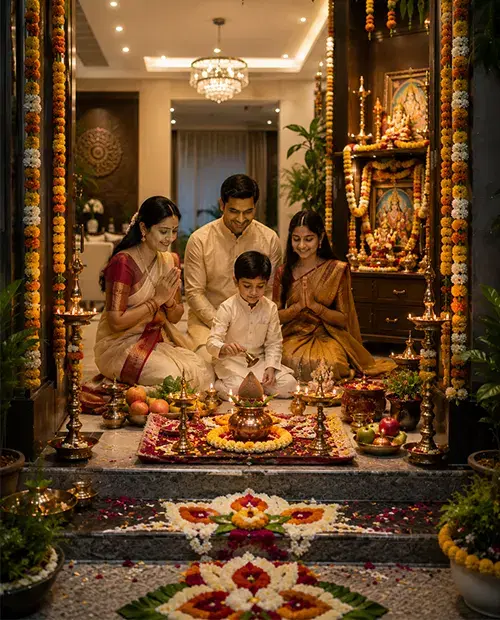
The prayer setup and the small temporary mandir for the puja go in the northeast corner, called Ishaan, which is treated as the most sacred direction. Idols and photos of deities are placed facing east. The kitchen belongs in the southeast, the direction of Agni or fire, which is why the milk boiling ritual happens there. The main bedroom sits best in the southwest. The main entrance should ideally open toward a favourable direction, and the doorway is decorated with mango leaves, flowers and a swastika to welcome good energy and keep negativity out.
If you live in an apartment and cannot control any of this, do not panic. Modern flats rarely line up with textbook Vastu, and priests routinely adapt. The intention and the puja still count.
Here is the process most families follow, whether a pandit runs it or you keep it simple at home.
- Finish the house completely first. Doors, windows, plumbing, electrical and painting should all be done, because Vastu for Griha Pravesh should not be performed in an incomplete house. Then clean and purify every room, often sprinkling Ganga jal to cleanse the space.
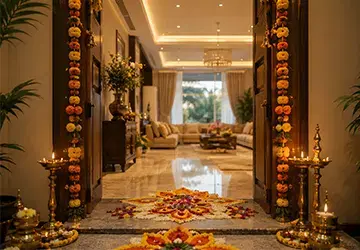
- Decorate the main entrance with a rangoli, fresh flowers and a mango leaf toran.
- Prepare the kalash. Fill a copper or brass pot with water and a little raw rice, arrange five to seven mango leaves around the rim, place a coconut on top and tie a red or yellow cloth around it. Keep it in the northeast near the puja area.
- Enter at the exact muhurat. The head of the household or the lady of the house steps in first with the right foot, carrying the kalash or a Ganesha idol.
- Break a coconut at the threshold, which is said to break negative energy and represent letting go of ego.
- Perform the puja in order: Ganesh Puja to remove obstacles, then Kalash Sthapana, then Vastu Shanti or Vastu Puja to honour Vastu Purush, then Navagraha or Graha Shanti Puja to settle planetary influences, and finally a havan. Let the havan smoke reach every room, which is why the house is kept fairly empty during the ceremony.
- Light the new stove for the first time and boil milk, sometimes with rice for kheer, letting it overflow as a sign of abundance flowing into the home. Offer the first cooked food to the deities, then share it as prasad with family, the pandit and guests.
- Do not leave the house empty for the next few days. Many families keep an Akhand Diya, a continuous lamp, burning for three to eleven days to hold the atmosphere.
The timing is treated as the single most important decision, so it is worth a little care. The date and time are chosen from the Panchang based on the tithi (lunar day), the nakshatra (star), and the day of the week, and ideally matched to the birth star of the head of the family or the wife.
Favourable months are often Magh, Phalgun, Vaishakh and Jyeshtha. Months to avoid include Ashadh, Shravan, Bhadrapad, Ashwin and Paush, which fall in the Chaturmas and Shradh periods and are considered inauspicious for house entry. The tithis of the 4th, 9th, 14th and Amavasya are usually skipped, and Tuesdays and Saturdays are generally avoided unless an astrologer says otherwise.
Good nakshatras include Rohini, Mrigashira, Anuradha, Chitra, Uttara Phalguni, Uttara Ashadha, Uttara Bhadrapada and Revati.
One practical note that trips a lot of people up: generic date lists and panchang apps are a starting point, not gospel. Abhijit Muhurat and Rahu Kaal shift with your city and sunrise, so a local pandit will give you a more accurate window than any national list.
Prices vary a lot, so treat these as ranges rather than fixed figures.
A basic, no-frills Griha Pravesh puja generally starts somewhere around 1,800 to 5,100 rupees, which usually covers the pandit’s dakshina and a standard samagri kit. A typical full ceremony with Vastu Shanti and a havan tends to land in the 5,000 to 15,000 rupee band in most cities. Once you add multiple pandits, Navagraha Homa, longer rituals and a bigger samagri list, elaborate packages can run from 25,000 rupees up to 75,000 rupees or more.
What moves the price? Your city, the reputation and language of the pandit, how long the ceremony runs, whether samagri is included, and how grand you want the havan. Many booking platforms now let you pay part in advance and settle the rest after, and most will send you a samagri checklist ahead of time so you are not scrambling on the day.
A knowledgeable pandit or purohit usually leads the ceremony, because the mantras, sequence and havan need to be done correctly, and a good priest also handles the muhurat and the Vastu portion. That said, a simplified Griha Pravesh can absolutely be done by the family alone, focusing on devotion and the core steps: cleaning, the kalash, entering with the right foot, lighting a diya, a simple Ganesha prayer, boiling milk and an aarti.
On who participates, a few traditional guidelines come up often. The puja can be done by a single person or, more commonly and more auspiciously, by a couple. Everyone dresses in clean, traditional clothes. Some families follow older customs around this, for instance many hold that a pregnant woman should not perform the ceremony herself, and that a household in mourning waits a set period before doing it. These vary by region and family, so it is worth asking your pandit about your specific situation rather than assuming.
Here is why families keep doing it, laid out simply:
- It clears the slate. The puja and havan are meant to remove the energy of previous occupants or construction and reset the home to a clean, positive state.
- It fixes Vastu doshas. Vastu Shanti settles imbalances in the layout and directions so the family starts on stable ground.
- It invites prosperity and protection. Prayers to Lakshmi and Ganesha are for wealth, luck, and fewer obstacles in health, money and relationships.
- It brings the family together. Doing the ritual as a household, then sharing food, strengthens bonds and marks the move as a real milestone.
- It gives emotional closure. The house shifts from being a purchase to being a home, which matters even to people who are not especially religious.
- It sets a calm, well-kept tone from day one, through the lamp, the cleaning, and the first cooked meal.
- It carries a sense of continuity, linking your new beginning to a practice your parents and grandparents followed.
The heart of Griha Pravesh has not changed, but the shape of it has, mostly because the way we live has changed.
The older version was long, elaborate and social in a big way. It was mainly done for a newly built house on land the family had chosen, often ran across a full protocol drawn from the Grihya Sutras, and involved feeding priests and a wide circle of relatives. A house was almost always an independent structure, so lining up the kitchen, entrance and prayer room with Vastu directions was realistic. The ceremony could stretch over hours or even span more than a day, and the guest list was large.
Today it looks different, and honestly it has become more practical. Most families live in apartments where you cannot dictate which way the kitchen faces, so priests adapt the rituals to fit flats and rentals rather than insisting on perfect directions. People book verified pandits online, compare transparent packages, and get a samagri list on WhatsApp instead of chasing everything themselves. Ceremonies are often shorter and the guest lists smaller, with many keeping the ritual tight and quality-focused rather than turning it into a crowd. A lot of people now do a Griha Pravesh even for rented homes, which older tradition did not really emphasise. NRIs and families who cannot gather in person increasingly opt for virtual or online pujas, with prasad couriered afterwards. There is also a clear shift toward eco-friendly samagri and simpler, less wasteful setups.
There is one more change worth naming. Interest in the ceremony actually went up after the pandemic, as people leaned into rituals that gave them a sense of stability during an unsettled time. So while the format has modernised, the underlying wish behind it, a safe and settled start, is arguably stronger than ever.
If you take the strict view, some of these shortcuts water down the original protocol. If you take the practical view, the tradition is doing exactly what a living tradition should, bending to fit real lives without losing its meaning. Both views are fair, and most families land somewhere in the middle.
Vastu for Griha Pravesh samagri checklist
Arrange everything a day or two before, so you are not running around on the morning of the ceremony. Buy the idols and kalash new for the home, since they usually stay as permanent fixtures. Here is the standard list most pandits ask for:
- New idols of Lord Ganesha and Goddess Lakshmi.
- A copper or brass kalash, plus a red or yellow cloth to tie around it.
- Coconuts, one for the kalash and a couple extra for breaking at the threshold.
- Fresh mango leaves for the kalash and an Ashoka or mango leaf toran for the door.
- Akshat, that is unbroken raw rice, along with turmeric (haldi), kumkum and sandalwood paste.
- Incense sticks, dhoop and camphor (kapoor).
- Diyas or lamps with ghee or oil and cotton wicks.
- Fresh flowers, loose and in garlands, and rangoli colours for the entrance.
- Ganga jal for purifying the house.
- Havan essentials: a havan kund, mango wood (samidha), ghee and a havan samagri mix.
- Navadhanya, the nine grains, if you plan to sprinkle them in the corners.
- Kitchen items for the milk ritual: a new stove or gas, fresh milk, sugar, rice and new grains.
- A new broom, to symbolically sweep away old energy.
- A puja thali, betel leaves and nuts (paan and supari), fruits, and sweets for the naivedya and prasad.
- Panchamrit ingredients: milk, curd, honey, ghee and sugar.
- Dakshina for the pandit.
If you have booked a pandit through a service, many of them send this exact checklist ahead of time, or include the samagri in the package. Confirm which items you need to buy yourself so nothing is missed on the day.
Griha Pravesh works on two levels at once. On one level it is a spiritual act, clearing the space and asking for blessings before you live there. On another it is a very human ritual that turns an address into a home and gives your family a proper beginning to mark. You can lean into the full traditional version or keep it small and heartfelt. What matters is that you do it with some care and intention, because that is the part that has always carried the meaning.
Benefits
Benefits of a Vastu-Compliant Griha Pravesh
Evolved Spiritual Ambience
Financial Escalation
Exceptional Health
Good Interaction
Vastu Tips
Important Tips & Points for Griha Pravesh
POINTS TO BE TAKEN UNDER CONSIDERATION
- Homes Should Never Be Vacant Post Ceremony, For Long Interval As It Welcomes Financial Loss
- Fire Essentials Like Stove and Lamps In Puja Room Should Always Be Placed In Right Direction To Avoid Digestion Related Issues
- All Pooja Essentials Should Be Kept In A Well-Organized Manner
- Positioning Deities Directly On The Floor Is Considered Very Unpropitious
- Using Dark Colour To Paint Your Pooja Room Invites Inauspicious Vibes To Your Home
Why Choose Us
Why Choose Layered Vastu for Griha Pravesh
100% Certified
Authentic Documents, Showcasing Legality100% Customer-Centric
Customization As Per Client's RequirementLifetime Assistance
Offering Services For The Entire LifespanFAQ
Vastu For Griha Pravesh - People also ask
Yes. It is better done before you settle in, but it is never treated as too late. If you have already shifted, you can still perform the puja to restore balance and invite positive energy. Many people do exactly this.
It is not mandatory, and it is usually kept simpler than for an owned home. Still, plenty of people do a short puja, a Satyanarayan puja, or at least light a lamp when moving into a rental, mostly for peace of mind and to make the place feel like their own.
Yes, a simple version can be done at home. Choose an auspicious date, clean and decorate the house, enter with your right foot holding a kalash and a coconut, light a diya, chant a basic Ganesha mantra, boil milk, sprinkle holy water and do an aarti. For a full traditional ceremony with a proper havan and Vastu Puja, a pandit is still recommended for accuracy.
Traditionally, no. The idea is to bless the home while it is fairly empty so the havan smoke can reach every corner and the space is purified in its purest form. Most families move only the stove and the mandir in beforehand, then bring the rest in after the ceremony. If you have already moved things in, you can still go ahead, it just is not the ideal setup.
A standard Griha Pravesh runs about one and a half to two hours. An elaborate one with multiple pandits and a full havan can take four to five hours or more.
Wait for the next auspicious window, or ask an astrologer about Abhijit Muhurat, which is more flexible. If you genuinely cannot avoid an off-muhurat entry, remedies like Ganesh Puja and Graha Shanti are believed to help restore balance afterwards.
Tradition says do not leave the new house empty for the first few nights after Griha Pravesh. Staying there helps "complete" the ritual and settle the home’s energy, which is why many families plan to stay at least three days.
Set up the puja in the northeast corner and keep the idols facing east. The kitchen ideally sits in the southeast, since the milk boiling ritual is tied to the fire element.
Roughly 5,000 to 15,000 rupees for a standard ceremony in most cities, with basic packages sometimes starting lower and elaborate ones going well past 25,000 rupees. It depends on your location, the pandit, the samagri, and how grand the havan is.
Explore More
Similar Vastu Services

Vastu For Bedroom
Make it Vastu Compliant
Read More
Vastu For Main Home Entrance
Make an auspicious entrance
Read More
Vastu For Cross Ventilation
Let the fresh air enter your home
Read More
Vastu For Garage
Welcome goodness from the garage
Read More
Vastu For Toilets
Make your living healthy
Read More
Vastu For Villa
Get the beautiful and positive living
Read MoreReady to Transform Your Space?
Get expert Vastu guidance from Seema Bhatia. Start your journey to harmony and prosperity today.