
What Is Office Vastu - and Why Does Layout Actually Matter
Vastu Shastra is an ancient Indian system of spatial design rooted in the flow of natural energies directional, elemental, and electromagnetic. When applied to office spaces, it examines how the positioning of key functions like leadership, accounts, sales, and operations aligns with these energy flows.
This is not about superstition. It is about understanding that human beings are affected by their physical environment. Natural light, air circulation, spatial orientation these influence mood, focus, and decision-making. Vastu codifies these observations into practical guidelines. When we assess a commercial space, we look at the placement of the owner's cabin, the direction the team faces, where finances are handled, and how visitors enter. Each of these has a measurable impact on how the business functions day to day.
Why Office Vastu Mistakes Hit Business Where It Hurts Most
A factory has machinery. A retail shop has inventory. An office has decisions, relationships, and cash flow. These are all invisible which makes them particularly sensitive to environmental disruption.
When leadership sits in a direction that creates mental pressure rather than clarity, you see it in the quality of decisions. When the accounts desk is placed in the wrong zone, money feels like it keeps slipping through. When the main entrance faces an unfavourable direction, clients walk in already uncertain. These effects accumulate slowly. Most business owners do not connect the dots because the problems look like business problems poor collections, high staff turnover, stalled growth. But the root is often spatial.
Common Office Vastu Mistakes Seen in Real Workspaces
These are not theoretical errors. These are patterns observed consistently across office assessments done by Layered Vastu across diverse business types.
Owner or MD sitting with their back to the entrance.
This is one of the most frequent office Vastu mistakes. When the decision-maker cannot see the door, it creates subconscious anxiety and a reactive management style. The best position for leadership is facing north or east, with a solid wall behind and a clear sightline to the entrance.
Accounts or cash management placed in the south or south-east zone.
The north is associated with Kubera, the energy of wealth and abundance. In Vastu for offices, when financial functions are placed in conflicting zones particularly the south, which governs outgoing energy cash seems to exit faster than it enters. We have seen this across multiple offices where the accounts team was shifted north and collections improved noticeably within a quarter.
Main entrance through the south or south-west.
South-west is the zone of stability and earth energy. An entrance here tends to attract effort without equivalent return clients come in, deals get discussed, but closure is difficult. North, north-east, and east-facing entrances are far more favourable for commercial spaces.
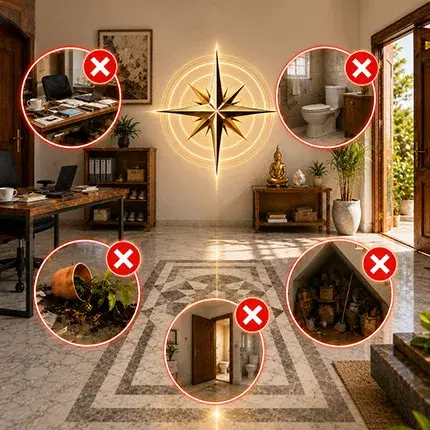
Toilets or pantry adjacent to the main cabin or accounts area.
Placing waste-generating or water-heavy areas next to core business functions creates energy interference. This is a common architectural shortcut in smaller offices where space is limited but the Vastu impact is significant. Even partial solutions like proper separation or elemental corrections can help.
Sales team facing south or west.
North-facing seating for the sales function aligns with the energy of communication and commerce. When sales teams face south, there is often more conflict than closure internally and with prospects. This is one of the simplest corrections to make and often produces visible results quickly.
How to Begin Correcting Your Office Vastu
You do not need to demolish walls or rebuild the office. Most corrections are about repositioning and intention, not construction.
Step 1: Map your office against the eight directions.
Use a compass to identify which zones fall where in your floor plan. Overlay this with current seating who sits where, what functions run from where. This mapping alone will show you immediate misalignments.
Step 2: Prioritise leadership and financial placement first.
If you can only change two things, move the owner's seating to face north or east and shift accounts to the north zone. These two changes address the majority of energy leakage in most offices.
Step 3: Address elemental imbalances.
Each zone is governed by a specific element earth, water, fire, air, space. If your layout has placed conflicting elements in the same zone, elemental corrections through colour, material, or placement can restore balance without structural changes.
Step 4: Get a professional assessment.
Self-assessment is a good starting point, but commercial spaces involve multiple energy layers. A proper Vastu consultation maps all of these together and gives you a prioritised correction plan.
Myths About Office Vastu That Hold Business Owners Back
The biggest myth is that Vastu corrections require major renovation. They rarely do. Most interventions are about placement, direction, and intention. Reorienting a desk, shifting the cash register, or adjusting the colour of a specific wall can produce measurable change.
Another common misconception is that Vastu is religious practice. It is not. Vastu is a spatial design system, the same way ergonomics is a workplace design system. Religion is a personal matter. Vastu is about your physical environment.
Finally, many founders believe that a good business model overrides everything. It does not. A strong strategy executed from a depleted environment will always underperform. Vastu is not a replacement for good business practice. It is the environment that allows good business practice to work at its full potential.
Conclusion
Office Vastu mistakes are not exotic problems. They are structural oversights hiding in plain sight in the direction of a chair, the placement of a desk, the position of an entrance. When these are corrected, the environment supports business instead of resisting it. If you suspect your workspace may be contributing to the friction in your business, a consultation with Layered Vastu can give you a clear, practical picture of what is working and what needs to change. Visit layeredvastu.com to explore consultation options.
FAQ
Frequently Asked Questions
The most impactful mistakes are: the owner sitting with their back to the entrance, accounts placed in the south or south-east, the main entrance facing south or south-west, and the sales team seated facing unfavourable directions. These four errors together create significant energy imbalance in commercial spaces.
Yes - particularly when financial functions are placed in zones with conflicting energy. The north zone governs wealth and prosperity in Vastu. When accounts or cash management sits in the south, the energy is oriented toward expenditure rather than accumulation. Correcting this placement has shown tangible improvements in payment timelines and collections.
In most cases, no. The majority of office Vastu corrections involve repositioning furniture, changing the orientation of key seats, and making elemental adjustments through colour, material, or plants. Structural changes are rare and usually only recommended when the core defect cannot be addressed otherwise.
Home Vastu focuses on rest, health, and family harmony. Office Vastu prioritises financial energy, leadership clarity, sales zones, and the movement of clients and decisions. The directional principles overlap, but the application is specific to commercial function.
Common signs include persistent cash flow issues despite good revenue, high staff turnover with no obvious HR reason, difficulty closing deals even when they look promising, chronic conflict between senior team members, and a general sense of stagnation in the business.
Related Posts
















Ready to Transform Your Space?
Get expert Vastu guidance from Seema Bhatia. Start your journey to harmony and prosperity today.