Where to Install an EV Charging Point at Home as per Vastu? Best Directions, Placement & Tips

Where to Install an EV Charging Point at Home as per Vastu? Best Directions, Placement & Tips

By Seema Bhatia|Updated: |12 min read

EV Charging Point Vastu is a modern application of traditional Vastu principles to the placement of an electric vehicle charger at home. Most Vastu practitioners suggest the South-East, a zone traditionally associated with Agni, the fire element. Where the South-East is not practical, South or East walls are common alternatives. The final location depends on your parking position, wiring route and a qualified electrician's safety checks, which always come first.

A new EV usually arrives before anyone has decided where its charger will go. The installer wants a wall close to the distribution board, the car's charging port is on one particular side, and the family wants the placement to respect Vastu. These three priorities can work together, and in most homes they do.

The EV Charging Point Vastu question has no single answer for every property. The right wall depends on your plot or flat layout, where the car actually parks, how far the cable must travel from the meter, and whether the space stays dry and ventilated. Vastu adds a directional preference on top of these facts. It does not replace them.

This guide explains where that preference comes from, which zones practitioners commonly suggest, how villas differ from apartment parking, and what to do when the preferred zone is simply not available.

Key Takeaways

  • South-East is the zone most practitioners suggest for electrical equipment because the Vastu Purusha Mandala assigns this corner to Agni.
  • Classical texts predate EV chargers, so any direction recommended for them is a modern practitioner interpretation of the fire principle.
  • Each property needs its own assessment: plot layout, parking position and wiring route can change the answer from home to home.
  • The wall that holds the charger and the direction your parked car faces are two separate decisions with different logic.
  • A safe setup needs a dedicated circuit, tested earthing, protection from water and a cable path nobody trips over.
  • South and East walls are common alternatives when the South-East is impractical; the North-West may suit the parking bay itself, depending on the layout.
  • When no preferred zone is available, a safe and accessible location takes priority over direction.

A qualified electrician and the vehicle or charger manufacturer's instructions determine the technical specifications. Vastu guides the choice between safe, practical options.


Understanding EV Charging Point Vastu

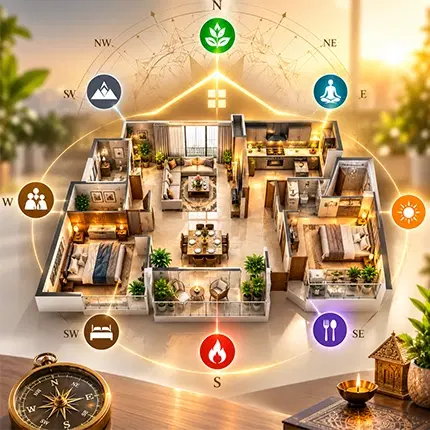
Vastu Shastra organises a site into directional zones. In the Vastu Purusha Mandala described in classical texts such as the Mayamata and the Manasara, each zone has a presiding deity, and the south-east corner belongs to Agni, the deity of fire. This is why the south-east is called Agneya, and why kitchens, which hold the household fire, are traditionally planned there.

Practitioners extend this logic to modern equipment. Electricity produces heat, light and power, so many consultants treat inverters, distribution boards and generators as fire-element objects, and an EV charger falls into the same category. Our guide to the 5 elements in Vastu explains how practitioners map materials and equipment to each element.

That extension is an interpretation, not a quotation.

Why a Modern Charger Needs Interpretation

No classical text mentions electric vehicles, wall-mounted chargers or lithium batteries. When a consultant recommends a direction for a charger, they apply a broader principle (fire belongs in the fire zone) to equipment the original authors never imagined.

Vastu Preference Versus Engineering Requirement

Treat the 2 layers separately. Engineering requirements cover circuit capacity, earthing, protective devices, cable sizing, weather protection and the manufacturer's mounting instructions. These are fixed. Vastu preference only helps you choose between locations that already pass those checks.

A charger in the preferred direction with poor earthing is a hazard. A charger on a safe wall in a less preferred zone is simply a working charger.

Best Direction for an EV Charging Point at Home

South-East: The Fire Zone

The south-east is the first recommendation in most Vastu guidance on electrical equipment. Because the zone is linked with Agni, practitioners see a charger there as equipment placed in line with its element. In an independent house, this usually means the south-east wall of a garage, porch or boundary.

If your distribution board is already in the south-east, the cable run stays short and the case becomes stronger on both counts.

South and East as Alternatives

Some practitioners accept the south wall when the south-east is unavailable, since it adjoins the fire corner. Others prefer the east, which the mandala links with Indra and the rising sun. These are practitioner preferences, and consultants differ on their order.

North-West and the Parking Bay

The north-west is governed by Vayu, the wind deity, and practitioners associate it with movement. Our garage Vastu guidance names the north-west and south-east as suitable garage zones. This makes the north-west a common choice for the parking bay itself, even when the charger ends up on a different wall.

No alternative suits every home. A south wall that floods in the monsoon is a worse choice than a dry east wall, whatever a directional chart says.

Zone, Wall and Car Orientation

These are 3 separate questions.

The directional zone describes where the charger falls on your property's grid. The wall describes the surface it is mounted on. The car's orientation describes which way the bonnet points when parked. A charger can be in the south-east zone of a plot while mounted on a north-facing wall within that zone. If you are unsure how to read your property's directions, start with our guide on how to find the facing of your house.

Table 1: Zones for a home EV charging point

Direction or zoneVastu interpretationPractical considerationsWhen individual assessment is needed
South-EastAgni's corner; first choice for fire-element equipment in most modern guidanceDistance from the distribution board, rain exposure, space beside the carWhen the zone holds a water tank or has no parking access
SouthAdjoins the fire corner; accepted by some practitionersOften offers long, usable walls; check sun and rain exposureWhen the main entrance or drainage outlets are on this side
EastLinked with Indra and sunrise; a second option for some practitionersUsually well lit; check direct sun on the unit and its outdoor ratingWhen the main entrance or a puja zone is on this side
North-WestVayu's zone of movement; often preferred for the parking bayPractical for driveways and gates; the charger may still go on another wallWhen the bay and the preferred charger wall pull in different directions
North-EastIshanya; traditionally kept light and openGenerally avoided for fire-element equipmentAlways, if this is the only available location
South-WestNairutya; linked with stability and weightPractitioners usually avoid fire equipment hereWhen parking is only possible in this zone
Centre (Brahmasthan)Traditionally kept openRarely relevant in houses; matters in stilt layoutsWhen cars park under the middle of the building

Directions and Locations That Need Extra Consideration

North-East Zone

The north-east, or Ishanya, is traditionally kept light, clean and open, and most practitioners prefer not to place fire-element equipment there. Our north-east corner guide explains why this zone receives that treatment. If a charger already exists in the north-east, it does not mean harm is coming to your household.

South-West Zone

The south-west, or Nairutya, is associated with stability and is often reserved for the master bedroom or heavy storage. Practitioners generally avoid fire equipment here. In many plots, though, the only parking access is on the south-west side, and a safe charger there is a better outcome than a long, exposed cable run to a preferred zone.

Centre of the Home

The Brahmasthan, the central zone, is traditionally kept open and free of heavy fixtures. Chargers rarely reach this zone in a house, but the question comes up in stilt parking, where cars park under the middle of a building. A perimeter column or wall is the better choice there.

No placement is worth an unsafe installation.

We do not tell clients that a charger in a non-preferred direction causes financial loss, illness or conflict. There is no evidence for such claims, and fear-based advice pushes people towards rushed, unsafe changes.

Placement in Different Types of Homes

Independent Houses and Villas

Villas give you the most choice. The usual approach is to plan the parking bay first, then pick the nearest wall in the south-east, south or east that keeps the cable run short. If you are building new, ask your architect to route a dedicated conduit to that wall before plastering. Our Vastu for Villa covers wider layout planning.

Covered Garages

A covered garage protects the charger from rain and direct sun. Map the garage's internal directions separately from the house: a garage in the north-west of the plot still has its own south-east corner. Keep fuel cans, paint and solvents away from the charger, and keep the garage ventilated.

Open Driveways and Car Porches

Outdoor chargers need an enclosure rated for outdoor use and a mounting height that keeps the unit clear of splashing water. Check where rainwater collects before choosing the wall. A porch canopy or small hood adds protection, and the cable should never cross the walking path to the main door.

Stilt and Basement Parking

Stilt and basement levels are often damp and poorly ventilated, which matters more than direction. Choose the driest, best-ventilated column or wall close to your slot, and confirm with the building's electrical team that the circuit can carry the load.

Apartment Parking and Shared Residential Spaces

In apartments, your allotted slot usually decides the location. Society permission, available electrical capacity, metering and the building's rules come first. The Ministry of Power's Guidelines for Installation and Operation of Electric Vehicle Charging Infrastructure 2024 include provisions for charging in residential premises and communities. How they apply depends on your state, electricity distribution company and society, so confirm current requirements before buying a charger.

Within your slot, use a reachable south-east or south column if there is one. If not, accept the safe option and focus Vastu attention on the Vastu for Flats, where you have more control.

EV Charger Placement Versus Car Parking Direction

The charger location and the vehicle's orientation need separate thought. Vastu guidance on parking commonly suggests that cars face north or east when parked, and our garage guidance follows the same view. The charger, as fire-element equipment, follows its own zone logic.

Charging Port Position and Cable Reach

Check which side of your car the charging port is on before you fix the wall. If the port is on the left rear and your preferred wall is on the right, you will stretch the cable across the car every night.

Tethered chargers come with a fixed cable length. Confirm it with the manufacturer and plan the wall so the cable reaches the port without strain or a loop lying on the floor.

Comfortable Parking and Daily Use

Leave room to open doors on the charger side, and keep the plug holder at a height everyone in the family can reach. An awkward charger usually ends with the cable left on the ground, a trip and damage risk.

Reversing into the bay solves a port on the far end. In our practice, the car's usual resting orientation is the Vastu consideration, not each charging session.

Safe EV Charger Installation at Home: A Practical Checklist

  1. Load assessment: ask a licensed electrician to check whether your sanctioned load and existing wiring can support the charger.
  2. Dedicated circuit: give the charger its own circuit and the protective devices the manufacturer specifies.
  3. Earthing: have the installer provide and test a proper earth connection.
  4. Water protection: mount the unit away from drainage outlets, taps and spots where water collects.
  5. Cable route: keep the charging cable off walkways and clear of the car's wheels when parked.
  6. Flammables: store fuel, paint and solvents well away from the charger.
  7. Manufacturer's manual: follow its mounting height, clearance and enclosure guidance, which differ between models.
  8. Utility approval: contact your electricity distribution company if you need a load increase or a separate meter.

Common Placement Mistakes

  • Choosing a direction first and asking about wiring later.
  • Ignoring monsoon water patterns on an open driveway.
  • Moving a safe, working charger out of fear rather than for a clear reason.

Practical Options When the Preferred Zone Is Unavailable

Many homes have no usable south-east wall near the parking. In that case, work down a simple order: a south or east wall near the bay, then any safe wall close to the distribution board, then the location your electrician recommends. Vastu attention can then shift to the rest of the home.

Some practitioners suggest keeping the charger area tidy and well lit, or adding a small red or orange accent nearby as a symbolic fire cue. These steps are optional and symbolic. They have no effect on charging speed, battery health or your electricity bill.

What We See in Client Consultations on EV Charger Placement

[PRACTITIONER OBSERVATION: Seema Bhatia to add 100 to 150 words on how often EV charger placement now comes up in residential consultations, and the most common situation clients bring to us. Keep it first-hand.]

Our approach follows the order set out in this guide. We first ask for the electrician's proposed locations, then read the property's directional grid, then choose the best option from that safe shortlist. We do not ask clients to move a safe, working charger simply because it falls outside the south-east.

[CLIENT CASE (ANONYMISED): city, property type, where the installer proposed the charger, what we recommended and why, and the outcome. Replace before publishing.]

Apartment consultations are shorter: the slot is fixed, so we confirm a safe installation and focus on the flat itself. For homeowners outside Delhi, we review floor plans, compass readings and photographs through an online Vastu consultation.

“Safety decides where a charger can go. Vastu helps you choose between the places where it safely can.”

Key Takeaways on EV Charging Point Vastu

Home EV charger placement works best when safety sets the shortlist and Vastu chooses from it.

  1. Ask your electrician for every safe wall near the parking before you consider direction.
  2. From that shortlist, prefer the south-east; fall back to the south or east if it is not available.
  3. Decide the parking orientation separately, checking port position and cable reach before fixing the wall.
  4. In apartments, secure society and utility approvals first, then apply Vastu within your allotted slot.

If you are planning a new home or garage, our residential Vastu consultation can review your layout before the electrician starts work.

About the Author

Seema Bhatia is the founder of Layered Vastu and a Vastu consultant and scientific logo designer with 12+ years of experience. She has guided 3,000+ clients across 5+ countries on residential, commercial and office Vastu, alongside numerology. She consults in person from New Delhi and online for clients worldwide, and has written around 50 guides on the Layered Vastu blog. Read her full profile.

FAQ

Frequently Asked Questions

The south-east is the direction most practitioners suggest, because Vastu links this corner with Agni, the fire element, and treats electrical equipment as fire-related. South and east walls are common alternatives. Your final choice should still follow your electrician's safety checks and your parking layout.

Classical texts such as the Mayamata and the Manasara say nothing about EV chargers, which did not exist when they were written. They assign the south-east to Agni. Modern practitioners extend that fire principle to electrical equipment, so any charger direction is an interpretation, not a classical rule.

You can if it is the only safe option. Practitioners traditionally keep the north-east light and open, so most prefer not to place fire-element equipment there. A charger in this zone does not cause harm. Keep the area tidy and consider relocating it during future electrical work.

The south-west is not ideal in Vastu terms, because practitioners associate it with stability and generally keep fire equipment elsewhere. However, if your only parking access is on this side, a safely installed charger there is a sensible outcome. Avoid long, exposed cable runs just to reach another zone.

No, they are separate decisions. The charger's wall follows the fire-zone logic, while parking guidance commonly suggests the car faces north or east. You need to check the charging port's position and cable reach, so the cable never stretches across the car or lies on the floor.

Vastu guidance commonly suggests parking with the car facing north or east, and many practitioners favour the north-west for the parking bay. You can read more in our garage Vastu guide. Your charger can still go on a different wall of the same bay.

In most cases, yes, but your society, electricity distribution company and the building's electrical capacity decide the details. You will usually need permission and a metering arrangement. Check the current rules that apply in your state before buying a charger, then apply Vastu preferences within your allotted slot.

No. There is no evidence that a charger's direction changes battery health, charging speed or your electricity bill. Those depend on the charger, the vehicle, your tariff and how you charge. Vastu placement is a matter of traditional preference, and we present it to clients that way.

If it is safe and working, you do not need to move it urgently. A charger in a non-preferred zone does not cause financial loss or illness. You can keep the area clean and well lit, and consider a better position when you next upgrade or rewire.

A covered garage protects the charger from rain and direct sun, which makes it the easier option. An open driveway works well with an outdoor-rated unit, a protective hood and careful attention to where water collects. Direction preferences apply in both, after the safety checks are done.

Yes, provided the building permits it and the circuit can carry the load. Damp and ventilation matter more than direction in these spaces. Choose the driest, best-ventilated wall or column near your slot, and use a perimeter position rather than the central zone wherever possible.

Consult a Vastu expert when you are building a new home, planning a garage or have several safe walls to choose between. A consultant reads your property's grid and picks the best option from your electrician's shortlist. They should never override the installer's safety requirements.

Consult a Vastu expert when you are building a new home, planning a garage or have several safe walls to choose between. A consultant reads your property's grid and picks the best option from your electrician's shortlist. They should never override the installer's safety requirements.

Ready to Transform Your Space?

Get expert Vastu guidance from Seema Bhatia. Start your journey to harmony and prosperity today.

WhatsApp Us Call Now