
Snapshot: What the 2026 Data Shows
- 62% of buyers prefer Vastu-compliant homes. A 99acres buyer survey found 62% prefer compliant properties and 44% will pay a premium for them.
- 93% preference in Tier-1 and Tier-2 cities. A Magicbricks survey reported 93% of respondents in these cities favour Vastu-compliant homes, near-universal in metros.
- ~80% treat it as a key decision factor. An Anarock survey found close to 80% of buyers weigh Vastu compliance when choosing a home.
- 15–25% faster sales, 5–15% higher price. Compliant homes reportedly sell 15–25% faster nationally, and fetch 5–15% more in competitive markets like Gurgaon and Mumbai.
- The Ishanya (north-east) rule drives demand. Classical texts reserve the north-east for water and prayer, the single placement buyers and agents check first.
From ‘Nice to Have’ to a Buyer’s First Filter
A decade ago, Vastu was the tie-breaker, the thing a buyer mentioned after price, location, and carpet area were settled. That order has flipped for a large share of the market. Compliance now works like an early screen. If a listing fails the basic checks, many buyers never schedule the visit.
The survey numbers explain why. When 62% of buyers say they prefer a compliant home and 44% will pay more for one (per a 99acres survey), a developer or reseller is no longer selling to a niche. They are selling to the majority. In Tier-1 and Tier-2 cities the pull is stronger still — a Magicbricks survey put preference at 93%.
This is a demand story, not a belief story. You do not have to personally accept every Vastu principle for the market effect to be real. The moment most buyers filter for it, compliance becomes a resale variable, the same way a covered parking spot or a corner unit does.
What the 2026 Numbers Actually Say About Resale
Reported figures vary by source and city, which is worth being honest about. The direction is consistent even where the exact percentage is not. Compliant homes move faster and tend to clear at stronger prices, especially where inventory is tight.
| Metric | Reported figure | Source (attribution) |
| Buyers who prefer compliant homes | 62% | 99acres buyer survey |
| Buyers willing to pay a premium | 44% | 99acres buyer survey |
| Preference in Tier-1 / Tier-2 cities | 93% | Magicbricks survey |
| Buyers treating it as a key factor | ~80% | Anarock survey |
| Faster sale vs. comparable homes | 15–25% | Industry / brokerage reports |
| Price premium in tight markets | 5–15% | Gurgaon & Mumbai market reports |
Availability data tells the same story from the supply side. A Business Standard report (September 2025) found Pune leads India for Vastu-compliant listings, with Mumbai at 54.7%, Navi Mumbai at 54.5%, Delhi at 52.6%, Indore at 47%, Bengaluru at 43.3%, Hyderabad at 43.1% and Chennai at 41.7% of homes for sale meeting compliance norms. When roughly half of a city’s inventory is already compliant, a non-compliant unit competes at a visible disadvantage.
Which Facings Sell Fastest - and Why the Premium Is Real
Not all compliance is priced equally. Direction is where the market puts hard money, because facing is fixed. You cannot repaint your way out of it. The demand order in 2026 is clear and stable.
The resale demand ranking: North-East > East > North
North-east-facing homes clear first and often at a premium, because the north-east, the Ishanya corner in classical Vastu, is treated as the most auspicious zone for light and water. East-facing units follow closely; agents grade them A-class and buyers chase them across income brackets. North-facing homes hold a strong, steady resale reputation for wealth and daylight.
The price signal is concrete. In Gurgaon, east-facing residential rates rose from about ₹9,718 per sq ft in 2023 to ₹16,186 per sq ft in 2025, with new-project east-facing units routinely selling out first. That is the market pricing a direction, not a superstition.
| Facing | Resale demand | What buyers associate with it |
| North-East | Highest - sells first | Light, water, prayer (Ishanya); premium pricing |
| East | Very high (A-grade) | New beginnings, morning sun, broad demand |
| North | Strong & steady | Wealth, career, reliable daylight and resale |
| West | Moderate | Acceptable if entrance and layout are correct |
| South-West facing entry | Lowest | Often discounted; needs careful correction |
What Makes a Home Vastu-Compliant - the Six Checks Buyers Run
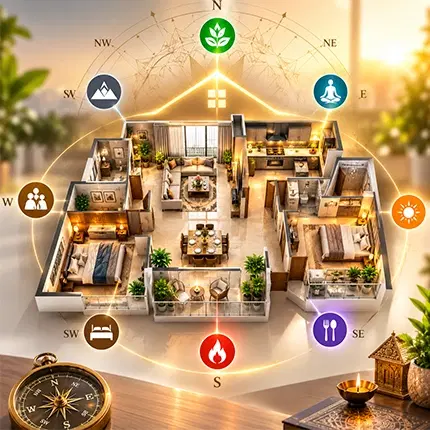
Compliance is not one thing. It is a short list of placements that classical texts assign to specific zones of the Vastu Purusha Mandala. Buyers who know the market run these six checks on any floor plan before they get emotionally attached to a view.
- Entrance in the north, east, or north-east. The main door is the mouth of energy in Vastu; north and east entries are the safest for resale.
- Kitchen in the south-east. The south-east is the Agni (fire) corner, the classical home of the hearth.
- Master bedroom in the south-west. The Nairitya (south-west) zone is linked to stability and the head of the household.
- Pooja room in the north-east. The Ishanya corner is reserved for prayer and water, per classical injunction.
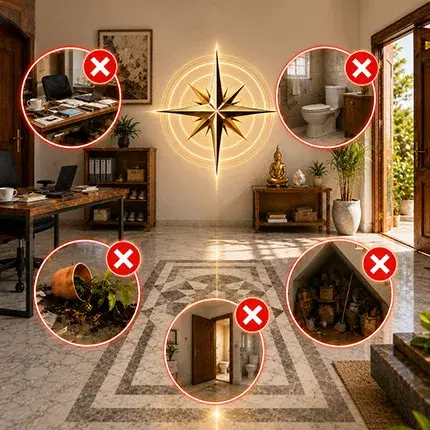
- Brahmasthan (centre) open and uncluttered. The middle of the home should stay light, not blocked by a heavy structure, tank, or toilet.
- No toilet or bathroom in the north-east. This is the single most common deal-breaker buyers flag.
If you want the room-by-room version, our Vastu for house guide walks through every zone, and the north-east facing house guide covers the most in-demand orientation in detail.
Facing gets the headlines, but resale is won or lost in the centre of the home. A blocked Brahmasthan or a north-east toilet quietly costs more at sale time than most buyers realise. Unlike direction, both are things you can plan around before you commit.
Where Compliance Is Easy to Fake - and How to Spot It
Because Vastu now sells, some listings claim it loosely. “Vastu-compliant” on a brochure is not a certification. It pays to verify the claims that actually affect resale rather than the decorative ones.
Two patterns come up again and again. First, a listing markets an east or north-east facing home, but the front door itself opens from an off-zone: the plot faces the right way while the entrance does not. Second, the North-East Corner Vastu is quietly compromised by a toilet, store, or staircase, which classical texts specifically warn against.
The good news for buyers: many issues are correctable without demolition. Colour, light, metal, and placement adjustments can rebalance a zone, the approach we cover in our non-invasive Vastu correction guide. Direction and the north-east are the two things worth being strict about, because they are the hardest to fix and the first things the next buyer will check.
What We See in LayeredVastu Client Consultations on Resale
In our practice, the buyers who call us before booking a home are rarely asking whether Vastu “works.” They are asking a sharper question: if I buy this unit, who buys it from me in seven years, and does the north-east toilet-as explained in Vastu For Toilets - cost me at that point? That is a resale question wearing a Vastu coat, and it is the right one to ask.
We assess the fixed elements first: facing, entrance zone, and the north-east. Those drive future demand and are the hardest to change. Everything else we treat as adjustable. Over 12 years across clients in several countries, the pattern holds: the homes that resell fastest are not the ones with the most remedies, but the ones that got direction and the centre right from the start.
[PRACTITIONER CASE STUDY - INSERT REAL ANONYMISED CLIENT EXAMPLE: e.g., a Gurgaon buyer who walked away from a discounted unit with a north-east toilet, chose a north-east-facing unit instead, and the outcome at resale / rental. Replace this bracketed placeholder before publishing.]
We do not promise price outcomes; no honest practitioner can. What we do is make sure a buyer understands which compliance factors the market rewards, so the decision is made with eyes open rather than on faith.
Key Takeaways Before You Buy or Sell
Vastu compliance has become a resale variable you can measure, not just a sentiment you can debate.
- Demand is now mainstream: 62% of buyers prefer compliant homes, up to 93% in Tier-1 and Tier-2 cities, and 44% will pay more.
- The market rewards it: compliant homes reportedly sell 15–25% faster and 5–15% higher in tight markets.
- Direction is priced: north-east leads, then east, then north, and facing is the one thing you cannot fix later.
- Guard the north-east and the centre: a north-east toilet or a blocked Brahmasthan costs the most at resale.
- Most other issues are correctable without demolition, so be strict on facing and flexible on the rest.
If you are weighing a specific home, a short pre-purchase Vastu assessment can tell you which factors are fixed, which are fixable, and what the next buyer will check. You can start with our Vastu for house guide or reach out for a consultation.
FAQ
Frequently Asked Questions
Yes. Industry and brokerage reports link Vastu-compliant homes to sales that are roughly 15–25% faster than comparable non-compliant units. The effect is strongest in Tier-1 and Tier-2 cities, where a Magicbricks survey found 93% of buyers prefer compliant homes, tightening demand for them.
In competitive markets like Gurgaon and Mumbai, compliant homes reportedly fetch 5–15% higher prices. A 99acres survey found 44% of buyers are willing to pay a premium. The exact figure varies by city and how strictly the home meets north-east and entrance rules.
North-east-facing homes sell first and command the highest premium, followed by east and then north. Agents grade east-facing units A-class. In Gurgaon, east-facing rates rose from roughly ₹9,718 per sq ft in 2023 to ₹16,186 in 2025, showing the market prices direction directly.
There is no single certificate. A home is considered compliant when key zones align with classical rules: entrance in the north, east or north-east; kitchen in the south-east; master bedroom in the south-west; pooja room in the north-east; and an open, uncluttered Brahmasthan at the centre.
Financially, yes. Even if you are neutral on the principles, most buyers are not. When 62% prefer compliant homes and up to 93% do in metros, compliance becomes a resale variable. You are buying an asset the majority of future buyers will actively screen for.
The Brahmasthan is the centre of the home, treated in Vastu as its energy core. Classical texts say it should stay open and light. A centre blocked by a toilet, heavy structure, or water tank is a common deal-breaker that quietly lowers buyer interest at sale time.
Yes, and it is the single most flagged issue. Classical texts reserve the north-east (Ishanya) for prayer and water, not waste. Informed buyers check this first, so a north-east toilet can shrink your resale pool and invite price negotiation, even when the rest of the home is otherwise well planned.
Often, yes. Colour, lighting, metal elements, and furniture placement can rebalance many zones without structural change. Our non-invasive Vastu correction guide covers this. However, fixed factors like facing and the north-east location are hard to alter, so verify those before you buy.
Per a Business Standard report (September 2025), Pune leads India, with Mumbai at 54.7%, Navi Mumbai at 54.5%, and Delhi at 52.6% of listings compliant. Bengaluru, Hyderabad and Chennai sit near 41–43%. Where half the inventory is compliant, non-compliant units compete at a disadvantage.
It does, and the same checks apply. For flats, focus on the entrance direction, the south-east kitchen, the south-west master bedroom, an open centre, and no toilet in the north-east. Facing is set by the building, so choose the unit within it that aligns best.
Lenders do not assess Vastu for loan approval; they value location, title, and resale marketability. Indirectly, because compliant homes tend to resell faster and hold value, they can be seen as sound collateral. Vastu never replaces legal due diligence, RERA checks, or clear title verification.
Run six checks: entrance in north, east or north-east; kitchen in the south-east; master bedroom in the south-west; pooja room in the north-east; an open Brahmasthan; and no north-east toilet. If a plan fails the entrance and north-east tests, weigh that before you get attached.
North-east edges ahead for pure resale demand and premium pricing, because it blends the auspicious Ishanya corner with strong morning light. East follows very closely and suits most buyers. Both outperform south and west facings, so either is a safe choice for future resale value.
Yes. The same buyer preference shows up among tenants, especially families. Well-planned north, east and north-east homes tend to rent out faster and hold rent better, because a large share of renters apply the same directional preferences they would use when buying a home.
Related Posts

















Ready to Transform Your Space?
Get expert Vastu guidance from Seema Bhatia. Start your journey to harmony and prosperity today.