Vastu Shastra Myths: What Classical Texts Actually Say

Vastu Shastra Myths: What Classical Texts Actually Say

By Seema Bhatia|Updated: |8 min read
12+ years of Experience
  • 3000+ Satisfied Clients
  • 5+ International Presence
  • 99% Success Rate
  • 100% Authenticity And Transparency

Vastu Shastra Myths and Scientific Facts Explained

If you have ever been told to break a wall, avoid a south-facing flat, or spend lakhs on crystals to “fix energy,” this guide is for you. We work on real homes and offices every week, and the same handful of Vastu Shastra myths cause most of the unnecessary spending. Below, we separate what classical Vastu actually says from what gets repeated online, so you can act on facts, not fear.

Where Vastu Myths Come From in the First Place

Vastu Shastra is one of the oldest documented systems of architecture in the world. Its principles sit in Sanskrit treatises written and compiled over centuries. Varahamihira's Brihat Samhita (sixth century CE) devotes Chapter 53 to architecture, city planning, house orientation, storeys and balconies. The Manasara and Mayamata (roughly fifth to tenth century CE) detail site selection, proportion and the famous Vastu Purusha Mandala, the grid that maps a plot into zones. These texts also help separate vastu shastra myths from authentic principles, and mention neither healing crystals, fear-based selling, nor mandatory renovation.

So why the noise? Three reasons. Vastu spread orally, so interpretations multiplied. It became commercially attractive, which rewarded fear over accuracy. And the internet blurred, regional customs, and personal opinion into one undifferentiated pile of “rules.” The result is a market full of confusion around vastu myths and facts, with confident claims that the source texts never made. That is the real problem we see in consultations: not bad homes, but good homes treated with bad information.

Myth 1: You Must Make Structural Changes to Be Vastu-Compliant

This is one of the most common vastu myths. People are told that compliance means breaking walls, shifting staircases, or rebuilding entrances before anything improves.

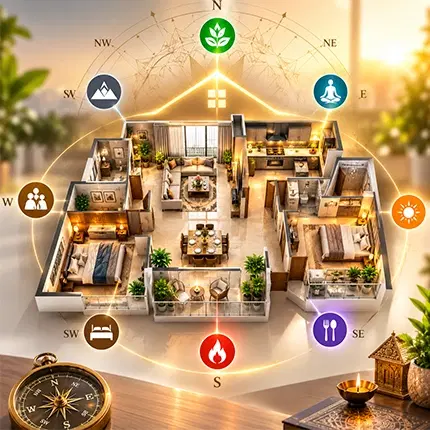
Reality: The truth about Vastu Shastra is that it concerns how a space is oriented and used, not constant demolition. The Manasara discusses choosing the right terrain and proportion at the design stage, the cheapest possible moment to get it right. For a home already built, Vastu facts vs myths become clearer, as most issues respond to placement and habit: where heavy furniture sits, how light enters, and whether the centre and north-east stay open.

In practice, the large majority of residential corrections we recommend are non-structural. Structural work is reserved for genuine, serious faults, a blocked main entrance, a heavily loaded Brahmasthan (centre), or water in the wrong zone. Even then, we cost it against the actual benefit before suggesting it.

Non-Structural Fixes That Do the Heavy Lifting

  1. Open up the north-east: clear clutter, heavy storage and shoe racks from this corner so light and air move freely.
  2. Anchor the south-west: place the heaviest furniture and storage here for stability and thermal comfort.
  3. Rebalance light and air: unobstruct windows, use cross-ventilation, and let the morning east light in.
  4. Use directional colour: calm, light tones in the north and east; grounding tones in the south-west.

Myth 2: South-Facing Homes Are Always Inauspicious

Many buyers reject a good property the moment they hear “south-facing,” and often pay a premium for north or east instead.

Reality: no classical text labels a direction as cursed. The south is governed by Yama associated with order, discipline and transformation, not doom. A south-facing house is linked in tradition with recognition and stability. The historical hesitation is climatic: in India's hot zones, an unshaded south face takes intense afternoon heat. That is a design problem, solved with shading, glazing and planting not a karmic verdict. What actually matters is the precise entrance position within the southern wall, the placement of rooms behind it, and keeping the north-east light. Handled well, a south-facing home performs as well as any other orientation. We have balanced many of them without the owner ever moving.

In twelve years of site visits, we have never seen a direction ruin a home. We have seen fear, clutter and bad placement do plenty of damage and all three are fixable.

Myth 3: Vastu Is a Religious Practice

Some people avoid Vastu because they think it belongs to one religion; others embrace it as ritual. Both miss what it is.

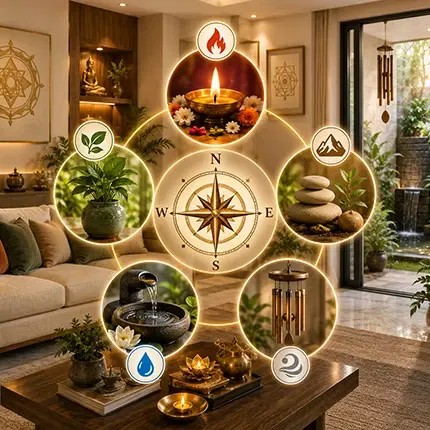
Reality: Vastu Shastra Myths is a discipline of architecture and environmental design. Its logic rests on the five elements, the Panchabhutas (earth, water, fire, air and space) and on the eight directions, the Ashtadisha. The deities attached to each direction are a symbolic map, a memory device for energy and orientation, not a demand for worship. The Brihat Samhita reads as a technical manual, not a scripture. People of any faith, or none, can use it.

Myth 4: Vastu Requires Costly Gemstones, Pyramids and Charms

This myth funds an entire industry. Homeowners are told that without a particular crystal, pyramid or yantra, nothing will work.

Reality: the core classical texts do not prescribe paid talismans at all. Manasara and Mayamata talk about orientation, proportion and the elements. The everyday tools that resolve most mild imbalances are ordinary and cheap: natural light, indoor plants, mirrors used with intent, a bowl of sea salt, and disciplined decluttering. Pyramids and gemstones can serve as optional aids, but they are not the engine of Vastu. If any advice leads with fear and ends with an invoice for crystals, treat it with suspicion.

Myth 5: A Toilet in the North-East Is an Automatic Catastrophe

The north-east toilet is the single most panic-inducing topic we encounter. Clients arrive convinced their home is beyond saving.

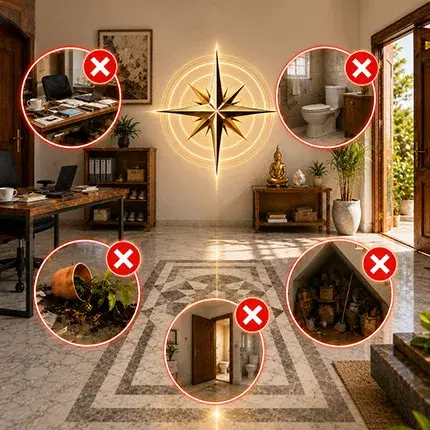
Reality: it is a real defect, not an automatic catastrophe. The north-east, or Ishanya, is the zone classical Vastu reserves for light, water and clarity, the corner that catches first morning sun. Older guidance discouraged a toilet there largely because of primitive drainage and hygiene. Modern plumbing, sealed waste systems and good ventilation change the equation. The defect is best avoided at design stage and ideally relocated, but where relocation is impossible, disciplined hygiene, ventilation, light colours, a closed door and indoor plants meaningfully reduce its impact.

One more correction here: placement matters far more than the direction the toilet seat faces. Turning a seat while leaving a badly zoned bathroom untouched fixes very little. Get the zone right first.

Myth 6: The Same Vastu Rules Apply to Every Home and Person

Generic checklists imply that one set of rules fits all. It is why two articles can give you opposite advice for the same room.

Reality: Vastu is site-specific. Plot shape, slope, the road, and structures around you, the exact entrance position, the number of floors, and the occupants themselves all shift the reading. The same north-west corner can suit one family and strain another. This also explains many vastu myths in modern homes and vastu myths for apartments. Vastu is not limited to homes; the Brihat Samhita addresses towns and public buildings, and the same logic guides offices, shops and factories. A real assessment is tailored; a copy-paste checklist is a starting point at best.

Classical Source vs Popular Belief - A Quick Reference

Popular Online ClaimWhat Classical / Practical Sources IndicateStatus
South-facing homes are cursedNo direction is inherently bad; south links to stability and fame; heat is a design issueMyth
You must demolish to complyTexts describe orientation and proportion; most fixes are non-structuralMyth
Vastu is a religionBrihat Samhita / Manasara are architectural manuals; open to all faithsMyth
Gemstones and pyramids are mandatoryCore texts prescribe orientation and elements, not paid talismansMyth
North-east toilet destroys the homeA genuine defect rooted in old drainage; manageable with modern systemsPartly true
Pooja room must be north-east onlyNorth-east/east preferred for morning light; treated as guidance, not lawOverstated
Vastu guarantees instant wealthTexts frame Vastu as well-being, not a results guaranteeMyth

For more on avoidable errors, see our guide to common Vastu mistakes to avoid, and if you are unsure which way your home faces, start with how to find the facing of your house.

The Scientific Thread Running Through Vastu

Stripped of fear, a good part of Vastu reads as sound building science for the Indian climate. East-facing light supports hygiene and mood. Cross-ventilation improves air quality. Heavier mass to the south-west aids thermal comfort and stability. Keeping the centre open echoes the idea of an uncluttered, breathable core.

These overlap with environmental psychology and climate-responsive design, and modern frameworks like the National Building Code of India reach similar conclusions about daylight and ventilation. Discussions around Vastu myths and scientific facts matter because not every Vastu rule has a scientific basis; some are cultural or interpretive, and the honest move is to say which is which rather than dress tradition up as proven fact.

What We Actually See in Client Consultations

In our practice, the pattern is consistent: people don't arrive with broken homes; they arrive with broken information. A family will have been quoted a large sum to relocate a staircase, or talked out of a sound apartment because it faced south. By the time they reach us, understanding Vastu Shastra Reality and Vastu Shastra Truth often reveals that the fear has done more harm than the floor plan.

A recent example: A Delhi homeowner was advised to demolish and reposition a north-east toilet at high cost. On site, we found the zone was salvageable, sealed plumbing, a dedicated exhaust, light wall colour, a kept-closed door, and two air-purifying plants. No wall came down. The household's main complaints were addressed with placement and hygiene discipline alone.
That is the LayeredVastu position in one line: respect the classical texts, test every popular claim against them, and never recommend a structural change you cannot justify on the day.

Our first job on most sites is to undo the panic. Once the fear is gone, the actual Vastu work is usually smaller, cheaper and far more effective than people expect.

The Bottom Line on Vastu Myths

Vastu rewards accuracy, not anxiety. Hold on to four things and you can ignore most of the noise.

  1. Check the source: if a “rule” isn't in the Brihat Samhita, Manasara or Mayamata, treat it as interpretation, not law.
  2. No direction is cursed south-facing homes work well with correct entrance and room placement.
  3. Most defects are fixed by light, air, placement and decluttering, not demolition.
  4. Be wary of any advice that leads with fear and ends with a bill for gemstones.

If you're weighing a property or a renovation, a single site-specific reading usually saves far more than it costs. You can explore our Vastu consultation services whenever you want a tailored, fear-free assessment.

Why Choosing Us

100% Certified

Authentic Documents, Showcasing Legality

100% Customer-Centric

Customization As Per Client's Requirement

Lifetime Assistance

Offering Services For The Entire Lifespan

FAQS

No. Classical Vastu names no direction as inherently unlucky. The south is governed by Yama and linked to fame and stability. A south-facing home stays balanced when the entrance pada, room placement and the north-east stay clear. Direction sets comfort, not fate.

Rarely. Most homes improve through placement, decluttering, light and ventilation rather than demolition. Texts like Mayamata describe orientation and proportion, not renovation. We fix the majority of residential defects without breaking a wall. Reserve structural work for severe entrance or Brahmasthan faults.

Neither. Vastu Shastra is a system of architecture and environmental design recorded in texts such as the Brihat Samhita and Manasara. It works with sunlight, airflow, geomagnetism and proportion. People of any faith, or none, can apply it. The deities are a symbolic map of directions.

It is a genuine defect, not an automatic disaster. The north-east, or Ishanya, is the light-and-water zone in classical texts. Old guidance feared poor drainage there. With modern plumbing, ventilation and discipline, the impact is managed. Relocation is ideal but not always required.

No. North-east and east are preferred because they catch the cleansing morning sun, but classical sources treat this as guidance, not law. What matters more is a clean, quiet, clutter-free corner away from toilets. A well-kept east wall in any room works.

No classical text demands paid talismans. Manasara and Mayamata discuss orientation, proportion and elements, not crystals. Light, plants, mirrors, salt and honest decluttering address most issues. Treat pyramids and gemstones as optional aids, never as the core remedy, and be wary of fear-led selling.

It applies to any built space. The Brihat Samhita covers cities, palaces and public buildings, not just houses. Offices, shops, factories and plots all respond to the same logic of light, flow and zoning. We apply identical directional principles across residential and commercial sites.

No. Vastu is not one-size-fits-all. Plot shape, slope, surroundings, entrance position and the occupants all change the reading. The same kitchen corner can suit one home and strain another. A real assessment is specific, which is why generic internet checklists so often mislead.

No honest practitioner promises that. Vastu shapes the environment around you; it does not override effort, skill or circumstance. Texts frame it as well-being and harmony, not a money machine. Treat any guarantee of overnight riches as a marketing red flag, not a Vastu principle.

The Brihat Samhita (Chapter 53), Manasara and Mayamata describe orientation, site selection and proportion using the eight directions and five elements. They favour east-sloping land and morning light. Many popular online rules are later additions, so always separate classical injunction from modern interpretation.

Placement matters far more than seat facing. The location of the toilet within the home's grid drives the effect; turning the seat alone rarely fixes a badly zoned bathroom. Focus on which zone the toilet sits in first, then refine fittings, ventilation and cleanliness.

Start with light and air, then declutter the north-east and centre. Rearrange furniture for free movement, place heavy items in the south-west, and use calm directional colours. Keep entrances clean and unobstructed. These non-invasive steps resolve most everyday concerns. See our common Vastu mistakes guide.

Several rules track sound building science: east light for hygiene, cross-ventilation for air quality, heavier mass to the south-west for thermal comfort. These overlap with environmental psychology and climate design. Other claims are cultural or interpretive, so it is fair to label science and tradition separately.

Use a checklist for small tweaks like colour, light and clutter. Call an expert before buying property, during construction, after recurring health, money or relationship trouble, or when advice online contradicts itself. A site-specific reading prevents costly, unnecessary changes driven by generic fear-based content.

They help, within reason. Mirrors can visually extend a cramped north-east, and plants improve air and lift a dull corner. But they correct mild imbalances, not serious structural faults. Place them with intent, keep them clean, and avoid mirrors facing beds or reflecting clutter.

Form Bg

Send Your Query