
The Science Behind Vastu Shastra Overview
Vastu Shastra is often mistaken for a set of religious rituals, but that’s not true. It is actually Vastu Vidya the ancient Indian science of architecture. As part of India’s Traditional Knowledge Systems (IKS), its principles come from the Atharvaveda and the Rigveda and aim to create harmony between buildings, nature & human well-being.
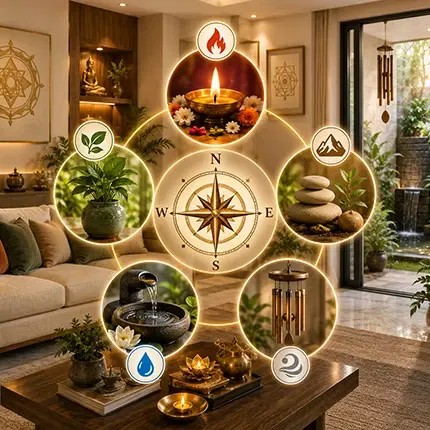
Ancient experts like the Sthapati (architect) and Vardhaki (mason) used these rules. Their goal was to balance the Pancha Mahabhutas. These are the five elements: Earth, Water, Fire, Air & Space. Vastu creates harmony between humans and nature. It is a tool for intentional, healthy living.
Scientific Principles of Vastu: Energy Fields, Magnetism, and Sun Path
Modern science helps us understand why these ancient rules work.
The Physics of Space and Neuroscience
Einstein’s equation, E = mc², shows that mass and energy are interconnected. Every material used in a building carries energy, and when enclosed within walls, it creates a subtle energy field. Modern neuroscience suggests that architectural spaces influence brain activity well-planned, balanced layouts can lower stress levels and support mental well-being.
Solar Geometry and UVB Radiation
The Sun is Earth’s primary energy source. Vastu emphasizes North and East orientations to welcome early morning sunlight, which is rich in UVB rays. This light supports Vitamin D synthesis and acts as a natural disinfectant, helping reduce germs and bacteria inside the home.
The Magnetic Connection and Human Haemoglobin
The Earth has a magnetic field running between the North and South Poles. Human blood contains iron in haemoglobin which is why Vastu refers to the body as a “living magnet.” Sleeping with the head toward the South and feet toward the North is believed to align the body with this magnetic flow, supporting smoother circulation, reduced stress, and more restful sleep.
The Weight Balance Theory and Earth’s Tilt
The Earth is tilted at about 23.45 degrees and is constantly in motion. For structural stability, buildings need balanced weight distribution. Vastu considers the South-West zone ideal for heavier and taller structures, as this placement is believed to enhance stability and grounding.
Mathematical Ratios and the Ayadi Formula
Vastu is not just about intuition or “vibes.” It incorporates precise mathematical principles known as Ayadi formulas. These ratios guide building dimensions to ensure proportional balance and harmony with natural and cosmic energies.
Clearing Up 7 Common Myths About Vastu
| Myth | Scientific Reality |
| Vastu is a religious practice. | It is a bioclimatic science of space & energy. |
| It is only about directions. | It covers airflow, light, and structural load points. |
| It requires demolition. | Simple furniture shifts or mirrors often work. |
| Ignoring it brings "bad luck. | It is about a lack of balance not magic. |
| Results are instant. | Biological and energy shifts take time to manifest. |
| It is only for residential homes. | It applies to offices, hospitals and smart cities. |
| Rules are the same everywhere. | Principles must adapt to local geography and climate. |
The Science Behind Each Room: A Practical Guide
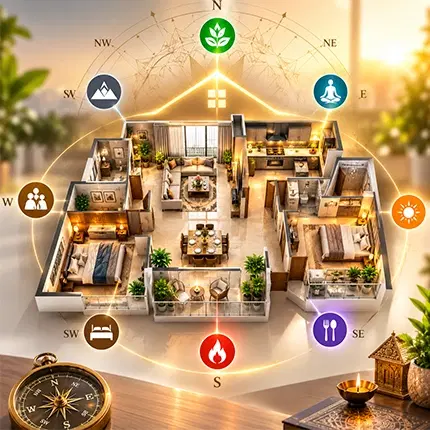
Entrance (North/East)
The entrance is designed to receive positive solar energy, allowing ample natural light to enter the space. This enhances hygiene, brightens the interiors and creates a warm, welcoming atmosphere.
Kitchen (South-East) Thermal Mass
The South-East is the "Fire" zone. It receives optimal solar exposure. This manages thermal comfort and keeps the area dry. Heat accumulation kills harmful bacteria in food zones.
Master Bedroom (South-West)
This corner offers the best stability. Positive energy enters the North-East and accumulates here. It creates a secure environment for deep rest.
Pooja Room (North-East)
The North-East is the most serene zone. Morning rays hit this area first. This creates a calm ambiance for meditation.
Living Room (Center) The Brahmasthana
The center should be a void. It is the Brahmasthana. This allows for unobstructed airflow and cross-ventilation.
Vastu in Modern Urban Planning: Case Studies
Jaipur The Pink City
Jaipur uses the 3x3 Pithapada nine-grid pattern. This layout manages zones efficiently. Streets align with the Sun's path for thermal comfort.
Chandigarh Le Corbusier’s Mandala
Le Corbusier incorporated principles similar to the Vastu-Purusha-Mandala in his planning. He positioned the “head” of the city, the Capital Complex in the North-East, reflecting the logic of the ancient mandala grid.
Angkor Wat Biophilic Design
This temple features a square-grid design that responds to solar radiation and magnetic fields, connecting the building to its environment.This temple features a square-grid design that responds to solar radiation and magnetic fields, connecting the building to its environment.
Easy Vastu Tips You Can Actually Follow
- Clear the North-East: Keep this zone open. It allows energy and light to flow.
- Protect the Marmsthanas: These are vital energy points. In engineering, they are load-bearing points. Do not place heavy walls on them.
- Use Psychological Colors: Use light hues like pink, beige, or light blue. These colors promote psychological relaxation.
- Square Floor Plans: Build square or rectangular rooms. These maximize floor area and airflow. Circular rooms waste space.
- Strategic Storage: Place heavy cabinets in the South-West. This maintains structural balance.
Final Thought : Ancient Wisdom, Modern Living
Vastu Shastra is a flexible guideline, not a rigid rulebook. It supports mental well-being, physical safety and sustainable living. Through Vastu Vidya, homes are designed to stay in harmony with nature and the universe helping create spaces that invite peace, balance and prosperity.
FAQ
Frequently Asked Questions
Yes. You can use furniture placement. Keep the North-East clear. Place heavy items in the South-West.
Square or rectangular shapes are best. They are more efficient for air and light. Circular rooms hinder airflow.
Yes. Vastu maximizes natural light and ventilation. This reduces the need for electricity and air conditioning.
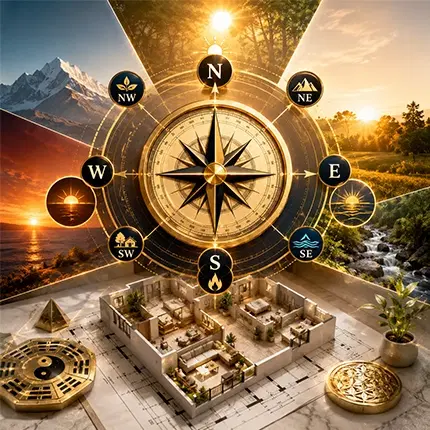
Morning sunlight purifies the water. It kills germs in tanks or pools placed there. Orientation of buildings in Vastu involves setting them to get maximum benefit from solar radiation. This is called Diknirnaya. The Vastu Purusha Mandala is a grid that facilitates zoning design as per usage or activities. Measurement of buildings in Vastu is categorized into six categories, including height, breadth, and width. This is to achieve harmony between the absolute and the quantifiable.
Related Posts







Ready to Transform Your Space?
Get expert Vastu guidance from Seema Bhatia. Start your journey to harmony and prosperity today.