
The Foundation: Two Sciences with Different Souls
Vastu Shastra is a science of space and energy. It explains how the orientation of your home — its entrance, rooms, and shape — affects the natural flow of forces like sunlight, wind, and magnetic fields.
Astrology, or Jyotish Shastra, is a science of time and planets. It explores how the positions of celestial bodies at your birth influence your life, emotions, and tendencies.
One governs the earthly structure you live in.
The other describes the cosmic imprint you are born with.
When you live in harmony with both, life flows smoothly. But when people try to mix them blindly — assigning planetary reasons for every wall, corner, or entrance — logic collapses.
The result? A person spends years searching for a “perfect” house that satisfies everyone’s horoscope — a home that doesn’t exist
Vastu Works for Everyone, Always
The first principle to understand is this: Vastu is universal.
Its rules are not designed for one person or one birth chart. They are designed for human beings in general — for families, communities, and collective wellbeing.
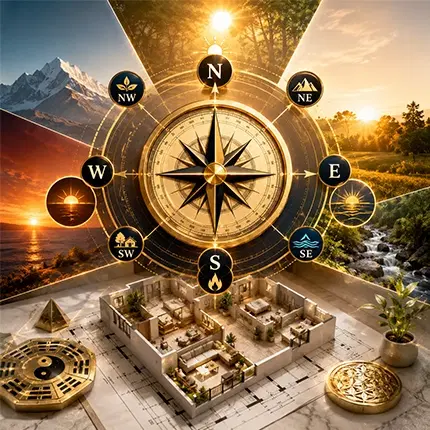
Let’s take entrances as an example. In classical Vastu, each side of a property — North, South, East, and West — is divided into eight energy zones known as padas. Not every section of a direction is good or bad. Only certain ones are auspicious.
For instance:
- S3 and S4 zones on the South side bring steady growth and strong leadership energy.
- N3 and N4 on the North side bring clarity and financial stability.
- E3 and E4 on the East side invite vitality, success, and recognition.
These are good for everyone — regardless of whether you’re an Aries or Capricorn, Manglik or not. Vastu’s energy fields don’t change with your birth chart.
Think of it like sunlight. The same morning sun rises for all, whether you were born in January or June. Similarly, when your home aligns with the Earth’s natural forces, it benefits all its residents equally.
Astrology’s Place: Personal, Not Structural
Astrology, however, deals with your individual journey. It describes your tendencies, opportunities, and challenges. It can reveal why two people living in the same house might experience different results — one feels uplifted, another feels restless.
In that sense, astrology can amplify or reduce the effects of Vastu. It might explain why a person enjoys quick progress in a Vastu-perfect home while another takes longer to see results.
But astrology does not rewrite Vastu’s laws.
It’s like driving a car on a highway.
Vastu designs the road — smooth, straight, and well-lit.
Astrology determines your vehicle — maybe a sports car or an old scooter.
The road remains the same for everyone.
Only your speed or comfort level differs.
That’s why experts say:
“Vastu decides the quality of your environment. Astrology decides the rhythm of your experience within it.”
When people confuse the two, they begin to fear directions, doors, and corners — which is not the purpose of either science
The Problem with Mixing Every Horoscope
Now imagine a typical family — a couple, their two children, and maybe grandparents.
If you apply astrological rules for each member before choosing or designing a home, chaos follows.
Let’s say:
- The father’s horoscope says a South-facing entrance is bad.
- The mother’s chart prefers East.
- The son’s chart warns against North.
- The daughter’s chart favors West.
What do you do? Build four houses?
This is exactly why fusing Vastu with every horoscope is impractical. A house is a single structure. It must have one entrance, one orientation, one kitchen, and one main bedroom.
If you start customizing each wall for each person’s planets, you’ll never finish building — because astrology is individual, but Vastu is collective.
That’s why true experts insist on keeping the two separate.
They work together only when you understand their boundaries.
Myth 1: Manglik Dosh and the South Entrance
One of the most persistent misconceptions is that people with Manglik Dosh should never live in homes with S3 or S4 (South) entrances.
The logic comes from a half-baked mix of astrology and superstition. It claims that because Mars (Mangal) represents fire and aggression, a South entrance — also associated with the fire element — would create conflict and accidents for Manglik individuals.
Sounds believable at first. But let’s test it with data and reason.
The numbers tell a different story
Studies and observations show that 40–43% of the population is technically Manglik.
If that’s true, almost half the world would be banned from living in South-facing homes.
That’s absurd.
Take a real-life example: Amitabh Bachchan’s family.
They live in a house with an S3/S4 entrance. Their family has eight members. Statistically, it’s almost certain that one or two are Manglik. Yet the family enjoys health, wealth, and worldwide respect.
So does this belief hold? Clearly not.
The logic collapses
If a South entrance were truly dangerous for Mangliks, millions of families across India would be facing ruin. But that’s not the case. In reality, when the South entrance falls in S3 or S4, it is one of the most powerful and positive positions in Vastu, promoting fame, authority, and confidence.
Manglik or not, the law of direction remains constant.
Hence the expert’s verdict:
“Having Manglik Dosh doesn’t mean you can’t have an S3/S4 entry. There is no connection.”
Myth 2: The Sun in a “Bad House” Makes East Entrances Harmful
Another myth says:
If the Sun in your horoscope rules or sits in the 6th, 8th, or 12th house — the so-called “inauspicious” houses — you should avoid an East entrance.
This claim assumes that a weak Sun clashes with the East, which is the Sun’s natural direction.
But again, the logic doesn’t hold up.
A personal example
One expert shared his own case. He has a Capricorn ascendant. For him, the Sun rules the 8th house, traditionally considered “Marak” or challenging. Yet, he lived for seven years in an East-facing E3/E4 home and worked for six years in an East-facing office.
If this myth were true, he should have faced constant setbacks. Instead, those years were among his most productive.
The mathematics proves it false
Every chart has planets in the 6th, 8th, or 12th house. If you start rejecting directions based on such placements, you’ll find no direction left to build in.
- Mars could rule your South.The Sun could rule your East.
- Saturn could affect your West.
- Mercury could sit in your North.
Apply these filters together, and every entrance becomes “bad.”
That’s why this entire logic crumbles when tested.
In pure Vastu, E3 and E4 are among the best zones for an East entrance. They invite growth, recognition, and mental clarity. Astrology does not cancel this rule; it only shapes how fast you experience the benefits.
The Subtle Truth of T-Points
T-points — where a road ends directly at your property — are another area where myths mix with fear.
In simple terms, a T-point means your house faces a road that stops right at your gate, forming the shape of a “T”.
Many people panic when they see one, thinking it guarantees accidents or financial loss. The truth is more nuanced.
Understanding the energy
A T-point acts as a direct channel for energy. In Vastu, it’s described as a “180-degree hit” from the direction it comes. For instance, an East T-point carries the fiery solar energy rushing straight into your space.
That can be good or bad — depending on where it hits.
If the T-point hits your main entrance directly, it can create overstimulation, aggression, or imbalance.
But if it hits a small corner or unused part of your plot, its impact is minimal.
The reality of “fixes”
Some people try to fix T-points by moving their main door to the side. While that reduces the direct hit, the property still receives that directional force. The energy doesn’t vanish; it just changes angle.
So yes, moving the entrance helps — but it’s not a full cure.
The practical solution is to analyze:
- The direction of the incoming road
- The exact angle of impact
- Which room or area it strikes
- The use of that space
If it’s a bedroom or main door — correction is needed.
If it’s a garage or open garden — the effect is small.
The important part is not to add unnecessary astrology to it. Mars or Venus in your chart doesn’t decide the power of a T-point. The site map does.
How Vastu and Astrology Can Work Together
Separating the two doesn’t mean ignoring astrology. It means using each for its true purpose.
Here’s how you can apply both wisely:
Step 1: Begin with Vastu for the property
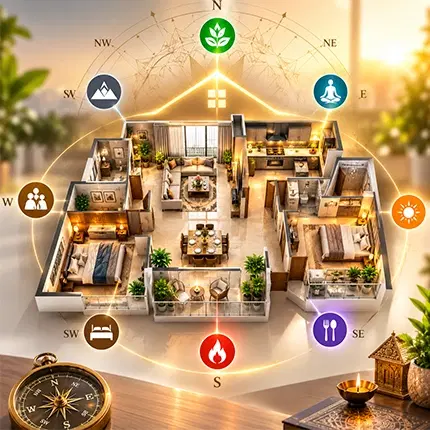
- Use a to-scale layout with accurate compass directions.
- Identify entrances, kitchen, bedroom, toilet, and staircase zones.
- Apply classical Vastu principles to enhance energy flow.
- Keep the design neutral and universally positive.
Once this foundation is solid, the home becomes energetically balanced for all residents.
Step 2: Use astrology for timing and personal alignment
After your home aligns with Vastu, you can look at astrology for:
- Choosing auspicious dates for purchase, construction, or move-in.
- Understanding favorable periods for business growth or renovation.
- Performing simple planetary remedies to enhance harmony — without altering structural design.
In short, build by Vastu, time by astrology.
That’s how the two sciences support each other.
Why This Clarity Matters
When people mix Vastu and astrology without understanding, fear replaces faith. Every wall becomes a worry, every room feels cursed. Consultants begin selling “quick fixes” that have no scientific or scriptural basis.
That’s not what our ancestors intended.
The sages who wrote Vastu Shastra Tips and Jyotish Shastra were scientists of their time. They worked from observation, mathematics, and geometry — not superstition. They designed systems meant to empower people, not trap them.
The true spirit of both sciences lies in balance and practicality.
When you apply Vastu correctly, your home naturally supports your body and mind.
When you use astrology wisely, you understand your inner patterns and timing.
When both align, life moves in rhythm with the universe.
Key Lessons to Remember
- Vastu and Astrology are distinct.
One manages your external environment, the other guides your internal journey.
- Vastu rules are universal.
A positive zone benefits everyone in the house.
- Manglik Dosh doesn’t cancel South entrances.
S3 and S4 remain beneficial zones in any well-planned house.
- Sun in the 6th, 8th, or 12th house doesn’t ruin East entrances.
E3 and E4 stay auspicious if the layout supports them.
- T-points need geometric correction, not astrological fear.
- You cannot design one home to match every family member’s chart.
That’s not how energy or architecture works.
- Astrology can time your actions but cannot change Vastu principles.
A Balanced Way Forward
Picture your home as a living organism — breathing, receiving, and responding. Vastu is its skeleton and nervous system, giving structure and flow. Astrology is its pulse, showing how energy moves through time.
If the skeleton is weak, no heartbeat can fix it.
If the pulse is weak, even a strong body feels tired.
But when both work together, life feels effortless.
That’s the true goal of these ancient sciences: to create alignment — between space and self, earth and sky, home and heart.
So before you reject a house because your Sun sits in the 8th, or avoid a South entrance because you’re Manglik, pause. Look at the evidence. Look at the logic.
Vastu works through geometry and physics. Astrology works through time and psychology. They are not enemies — but neither are they interchangeable.
Understanding their boundaries gives you freedom.
And in that clarity, you’ll find what both sciences truly promised —
a life in harmony with nature and destiny, not in fear of them.
Related Posts







Ready to Transform Your Space?
Get expert Vastu guidance from Seema Bhatia. Start your journey to harmony and prosperity today.