
What does the term Vastu Shastra actually mean?
The word itself tells you a lot. Vastu (वास्तु) is Sanskrit for "dwelling" or "site" — specifically, a place that is meant to be lived in. Shastra (शास्त्र) means "science", "doctrine", or "treatise". Put together, Vastu Shastra translates to "the science of dwelling" or, more loosely, "the doctrine of architecture for habitation".
That phrasing is useful because it captures something modern translations often miss: Vastu was never just about aesthetics or symbolism. It was a working architectural science. The classical texts contain measurements, ratios, material specifications, and building protocols. They are closer in spirit to a building code than to a horoscope.
That said, Vastu Shastra also includes an energetic dimension. The same texts that specify wall thicknesses also describe the elemental energies (the Pancha Bhuta) that flow through a property and how the design either supports or obstructs them. Understanding both halves matters. Vastu is structural and energetic. The modern practitioner's job is to translate the classical principles into recommendations a contemporary client can actually act on.
The five elements (Pancha Bhuta)
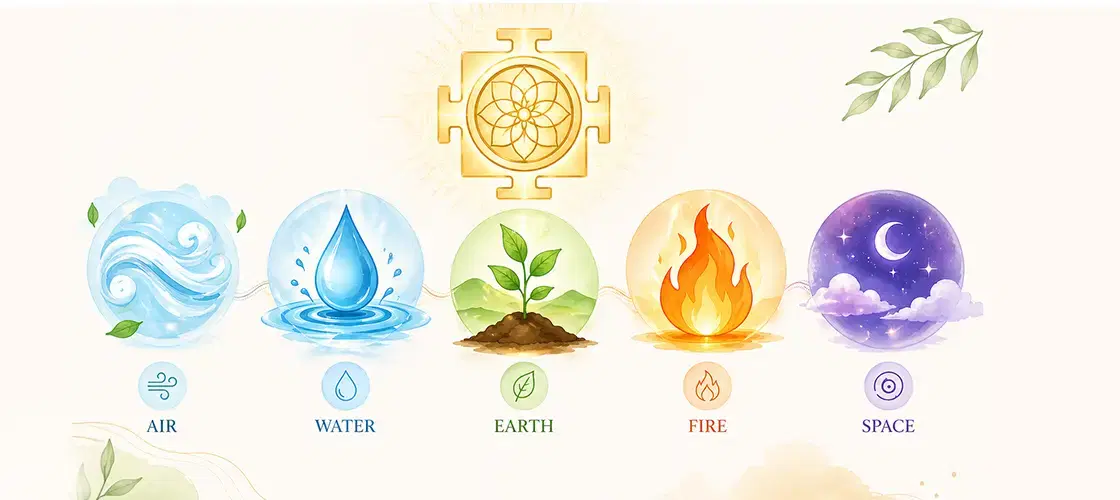
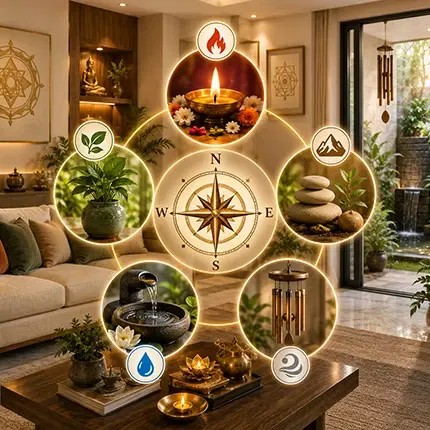
Vastu Shastra is built on the concept of the Pancha Bhuta, the five fundamental elements that compose all matter and energy in classical Indian thought. They are:
- Earth (Prithvi) — solidity, weight, support, stability. Governed by the south-west direction.
- Water (Jal / Apas) — flow, fertility, emotion, money. Governed by the north-east direction.
- Fire (Agni / Tejas) — transformation, energy, ambition, digestion. Governed by the south-east direction.
- Air (Vayu) — movement, communication, intellect, breath. Governed by the north-west direction.
- Space (Akasha) — openness, sound, the medium for everything else. Governed by the centre of the property (Brahmasthan).
Every zone of a property is associated with one of these elements. A Vastu reading checks whether each zone is being used in a way that supports its element, or in a way that fights it.
For example: a kitchen contains fire (the stove) and water (the sink). Classical Vastu places the kitchen in the south-east the fire zone so the stove is in its native element. The sink within the kitchen sits to the north-east of the stove so water doesn't directly oppose fire. Two simple rules, derived from the elements, that govern almost every kitchen layout decision. The Pancha Bhuta framework is the reason Vastu rules feel consistent rather than arbitrary. Every recommendation traces back to which element belongs where.
The eight directions (Asta Dik) and what each governs
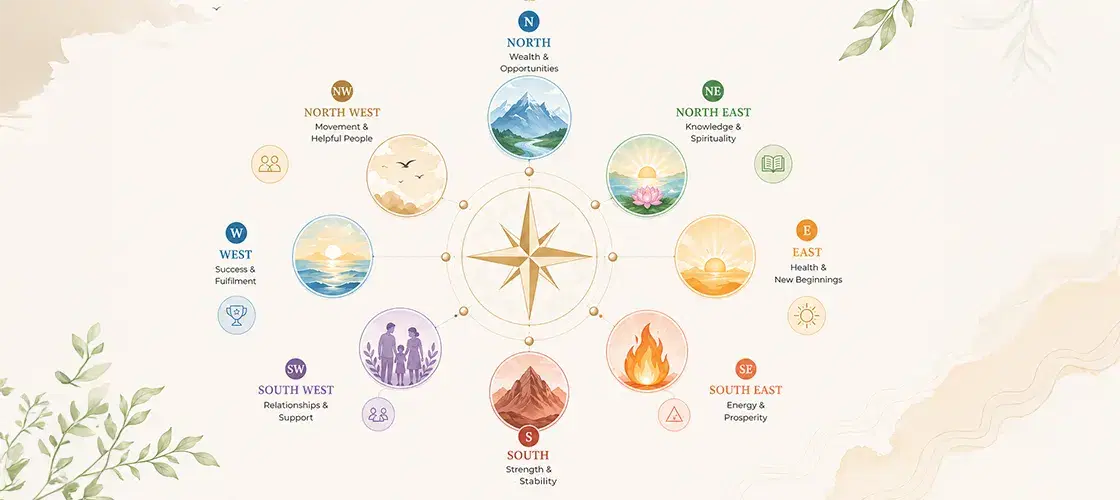
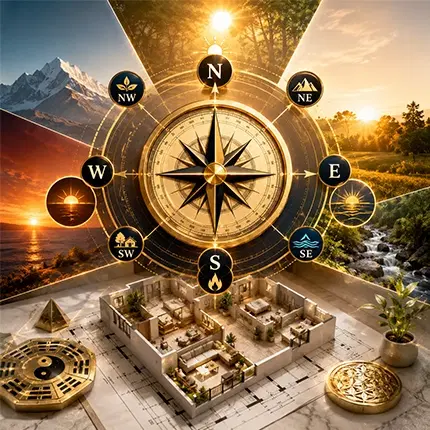
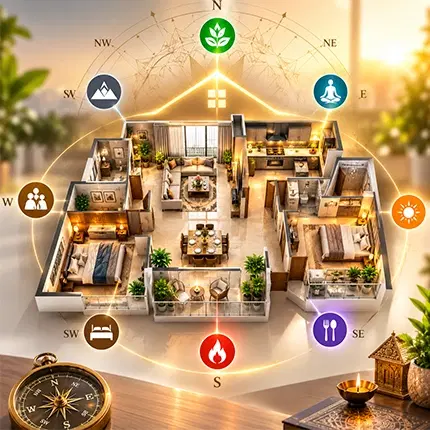
Vastu's other core framework is directional. There are eight directions: the four cardinals (North, East, South, West) and four ordinals (North-East, South-East, South-West, North-West). Each is governed by a specific deity in classical texts and associated with a specific element, energy, and life domain.
Here is the standard mapping practitioners use:
| Direction | Deity | Element | Governs |
| North | Kuber | Water | Wealth, financial movement, opportunities |
| North-East (Ishanya) | Ishan / Shiva | Water | Spirituality, clarity, wisdom - the most sacred zone |
| East | Indra | Air | Health, social connection, sunrise energy |
| South-East (Agneya) | Agni | Fire | Energy, ambition, digestion - kitchen zone |
| South | Yama | Fire | Fame, recognition, but also death (handle with care) |
| South-West (Nairutya) | Nirruti | Earth | Stability, rest, accumulation - master bedroom and owner's seat |
| West | Varun | Water | Gains, profits realised |
| North-West (Vayavya) | Vayu | Air | Movement, change, guests, marriage |
A Vastu reading checks every room and major object against these directional associations. The master bedroom should be in the south-west (earth, stability) not the north-east (water, wakefulness). The kitchen should be in the south-east (fire) not the north-east (water, opposite of fire). When a property's layout aligns with these directional principles, the classical view is that energy flows naturally and the occupants benefit. When the layout works against the directions, it creates Vastu defects (doshas) that need correction.
The Vastu Purusha Mandala - Vastu's central tool
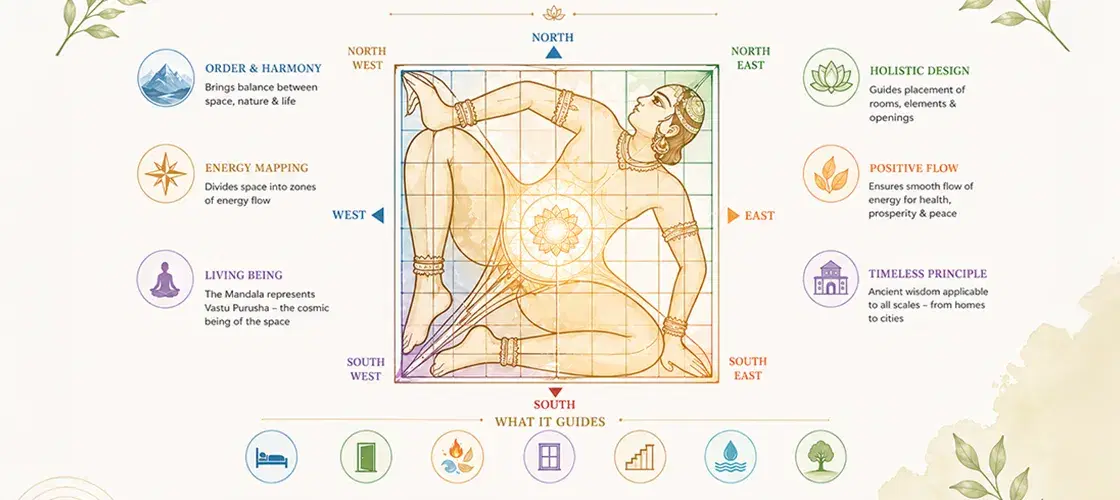
The framework that holds the directions, elements, and zones together is called the Vastu Purusha Mandala. It is a square diagram that represents the cosmic person (the Vastu Purusha) lying face-down on the property, his body aligned with the directions and his various organs corresponding to specific zones. There are several Mandala forms. The most commonly used in residential consultations is the Paramasayika Mandala a 9×9 grid of 81 cells. Larger commercial projects sometimes use the Manduka Mandala (8×8, 64 cells) or the Sthandila Mandala (7×7, 49 cells).
The Mandala does three things at once:
- It shows which deity governs which cell of the property
- It shows which element belongs in which zone
- It shows how to position rooms, doors, water elements, and heavy objects
A Vastu reading typically begins by overlaying the Mandala on the floor plan. From there, every defect can be identified by name (which cell, which deity, which element imbalance) and every remedy can be calculated from the same reference. When you see a Vastu consultant marking up a floor plan with red and green zones, they are essentially translating the Mandala onto the property's actual geometry. The Mandala is the bridge between the abstract directional rules and the specific home.
Where Vastu Shastra came from
Vastu Shastra is one of the four Upaveda the secondary Vedic sciences. It belongs to the Sthapatya Veda, the Veda of architecture, which is itself a sub-discipline of the Yajurveda. The earliest references are about 5,000 years old. The most influential classical texts were compiled between 500 BCE and 500 CE:
- Manasara — the most comprehensive Vastu treatise, covering everything from town planning to temple architecture
- Mayamata — focused on residential and palace architecture
- Vishwakarma Prakash — attributed to Vishwakarma, the divine architect
- Samarangana Sutradhara — an 11th-century compilation by King Bhoja
These texts are remarkable for their precision. They specify wall thicknesses, beam-to-column ratios, brick sizes, and timber joinery in detail. The energetic and ritual aspects are intertwined with hard architectural specifications.
Vastu also influenced architectural traditions beyond India. The earliest Buddhist monasteries in Sri Lanka and Southeast Asia followed Vastu principles. Hindu temple architecture, both in India and abroad, is essentially applied Vastu Shastra. Even modern Indian government buildings sometimes incorporate Vastu consultations during planning. The reason the discipline has endured is that it works at multiple levels physical, environmental, and energetic using a single coherent framework.
How Vastu Shastra actually works (the practitioner's view)
After twelve years of practice and 3,000+ consultations, here is how I would explain what Vastu actually does — without overselling it and without dismissing the parts that are real:
At the physical level, Vastu rules optimise for things modern environmental science also values: cross-ventilation, natural light, thermal balance, and acoustic separation. A north-east-oriented main entrance gets early-morning sunlight. A south-west master bedroom is the cooler, more shaded part of the house. A south-east kitchen places the stove where wind patterns naturally vent smoke away from living areas. These rules made sense in the climate of pre-industrial India and they make sense in most Indian climates today.
At the spatial level, Vastu rules create good circulation patterns. The Mandala-based zoning naturally separates active areas (kitchen, dining) from passive areas (bedroom, study). It positions storage and utilities away from main living spaces. It creates a hierarchy of public to private as you move through the home. These rules align with what modern interior design research calls "spatial flow" and "activity zoning".
At the energetic level and this is where modern Vastu has to be honest about what it can and cannot prove Vastu treats space as carrying influence. The directional associations, deity assignments, and elemental mappings are part of a coherent system that practitioners and clients have used for millennia and continue to find effective.
I am not in the business of asking clients to take that on faith. What I tell them is: try the recommendations. If your sleep improves when the bed shifts, your business cash flow stabilises when the cash counter moves, and your home feels different in a way you can describe, then the system is doing something useful. If nothing changes, you have lost a few hundred rupees on a brass diya and a wall colour. In practice, almost every client reports something often subtle at first, sometimes dramatic. The pattern across thousands of consultations is what gives the discipline its credibility, not any individual claim.
The most common Vastu defects in modern homes
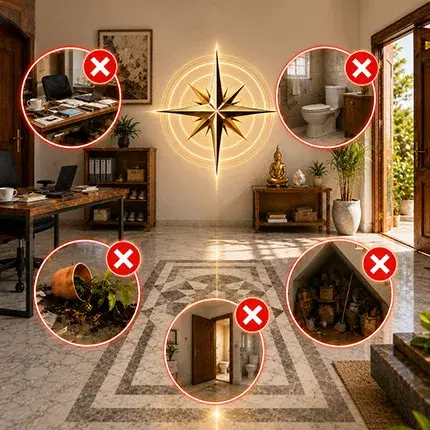
After 3,000+ residential consultations, certain defects appear over and over again. Here are the most common ones I see, with the brief explanation of why each matters and the kind of remedy that addresses it:
1. South-facing or south-west-facing main entrance. The south is governed by Yama (death) and the south-west by Nirruti (stability of the earth element, but resistant to inflow). An entrance here disrupts the flow of opportunities and money into the home. Remedies focus on the threshold and door colour rather than relocating the entrance.
2. Kitchen in the north-east. The north-east is the water zone. Putting fire (the stove) there is direct elemental conflict. Many flats are designed this way for convenience and natural light. The remedy is a careful balancing of materials and a specific copper element placement.
3. Master bedroom in the north-east. This is the wisdom and clarity zone meant for meditation, study, or pooja, not for the deep sleep and stability associated with the south-west earth zone. Common in smaller flats where the master bedroom gets the corner with the best view, which is often the north-east. Remedy involves bed orientation and colour adjustments.
4. Toilet in the centre of the property (the Brahmasthan). This is the energy hub of the entire space. A toilet at the centre is one of the most disruptive Vastu defects. When the toilet cannot be relocated, layered remedies focus on door treatments, sea salt, and specific colour and material corrections to seal off the energetic damage.
5. Staircase in the north-east. A staircase in the sacred zone disrupts upward energy flow. Remedies use directional plates, specific railing materials, and lighting adjustments.
6. Mirror facing the bed. Beyond classical Vastu, this is also flagged in Feng Shui and many spiritual traditions. The energetic explanation is that a mirror reflects and doubles whatever energy is present, which during sleep amplifies subconscious activity. Simple remedy: reposition or cover the mirror.
7. Sleeping with the head pointing north. Earth's magnetic field runs roughly north-to-south. Sleeping with the head north means the magnetic pull works against the body's blood circulation. Vastu (and modern sleep researchers like Dr Stuart Bowen) recommends head-south or head-east. This is the easiest defect to fix just turn the bed.
Each of these defects, in the Layered Vastu method, is correctable without demolition. The five-layer approach (placement, colour, materials, symbols, personal alignment) handles every one of them through movable adjustments. Read more on the Layered Vastu Methodology page https://www.layeredvastu.com/methodology.
Vastu Shastra vs Feng Shui: what's actually different
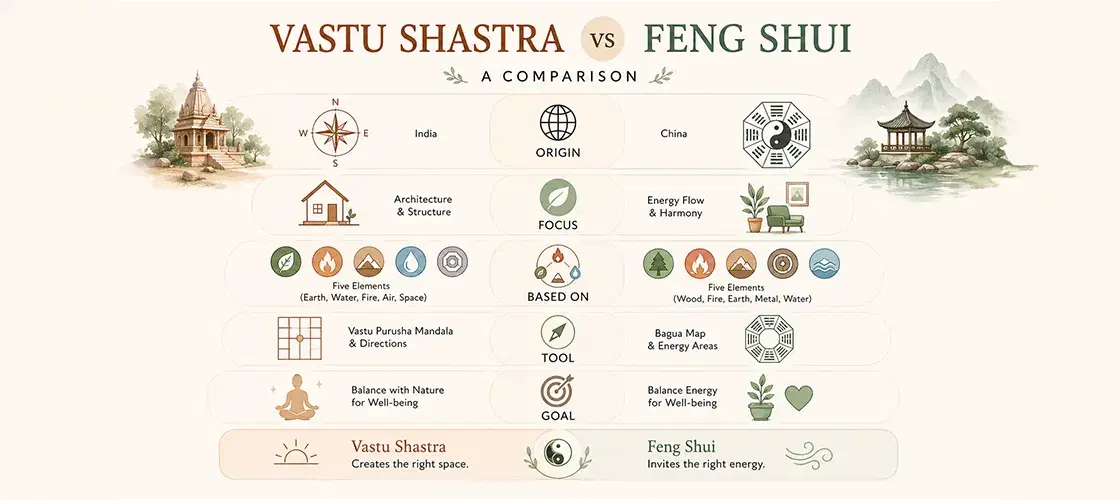
Both Vastu and Feng Shui are ancient spatial-energetic systems. They share so much that many clients arrive thinking they are the same discipline with different names. They are not.
Here is what's actually different:
| Dimension | Vastu Shastra | Feng Shui |
| Origin | India (~5,000 years old) | China (~3,500 years old) |
| Core framework | Five elements (earth, water, fire, air, space) | Five elements (wood, fire, earth, metal, water) |
| Directional approach | Eight fixed directions, deity-governed | Bagua map, oriented to compass or front door |
| Building shape preference | Square or rectangular | More flexible, including curves and "flow" |
| Time element | Largely static | Time-sensitive (Flying Stars updates yearly) |
| Practitioner role | Architectural and energetic | Often more divinatory and consultative |
The two systems share the same core insight that space affects people and reach similar conclusions on many specific points (avoid bed under a beam, keep clutter out of the entrance, etc.). They diverge on the details.
For Indian clients, Vastu generally feels more natural because the directional and elemental vocabulary is woven into the culture. For non-Indian clients, the choice often comes down to which system's logic resonates more with how they think.
You can practise both. Many of my international clients started with Feng Shui and now use Vastu alongside it. The systems agree more than they disagree.
Types of Vastu by property
Vastu principles apply to every type of building, but the specific rules differ by property type. At Layered Vastu, we work across all six categories:
- Residential Vastu https://www.layeredvastu.com/residential-vastu-expert — Vastu for homes, flats, and apartments. The most common service. Focuses on entrance, room layout, kitchen, and master bedroom.
- Commercial Vastu https://www.layeredvastu.com/commercial-vastu-expert — Vastu for offices, shops, restaurants, and hotels. Emphasises owner seating, cash counter, and customer flow.
- Industrial Vastu https://www.layeredvastu.com/industrial-vastu-expert — Vastu for factories and warehouses. Addresses machinery placement, raw and finished material storage, and worker areas.
- Everyday Vastu https://www.layeredvastu.com/everyday-vastu — Daily life applications: sleep direction, work direction, daily clothing colours, mirror placement.
- Numerology https://www.layeredvastu.com/numerology — A separate discipline used alongside Vastu. Calculates life path, expression, and personal year numbers from birth date and name.
- Scientific Logo Design https://www.layeredvastu.com/scientific-logo-design — Logos created using Vastu and numerology principles aligned to the founder's chart.
Each property type has its own Frequently Asked Questions https://www.layeredvastu.com/frequently-asked-questions and case studies https://www.layeredvastu.com/case-study.
Modern Vastu and the non-demolition approach
Classical Vastu Shastra was written for an era when buildings were designed before they were built. The architect, the priest, and the client met during planning. Vastu was applied at the design stage. That assumption no longer holds for most clients. By the time someone reaches out to a Vastu consultant in 2026, the home is built, the kitchen is fitted, the children's rooms are decided. Demolition is impractical, expensive, and usually not what the client wants.
This is the gap the Layered Vastu method fills. It is a non-demolition implementation of Vastu Shastra that corrects defects through five layers applied together at calculated points: placement of objects, colour adjustments, material selection, symbolic objects, and the occupants' personal alignment via numerology. No single layer carries the whole correction. Applied together, they produce the same energetic effect as moving the kitchen without moving the kitchen.
The method works for owners of finished homes, renters with limited control, commercial businesses operating in leased premises, and industrial facilities that cannot stop production. It also works remotely, which is why Vastu consultations from Indian diaspora clients in the US, UK, Canada, and Australia have grown to a meaningful share of the practice. For full background, see The Layered Vastu Method https://www.layeredvastu.com/methodology.
When to consult a Vastu expert (and when not to)
A Vastu consultation is most useful when:
- You are buying or moving into a new property
- You are designing or building from scratch
- You are experiencing patterns of difficulty stalled finances, sleep problems, repeated household friction and have ruled out the obvious causes
- You have been told by someone else that demolition is required and want a second opinion
- You are starting a new business or registering a company name
- A child is being named or a wedding is being planned
A Vastu consultation is not the right tool when:
- You have an active medical issue see a doctor first
- You have a structural building problem (cracks, water seepage, code violations) see a structural engineer
- You are looking for a quick fix to a deep relationship, business, or financial problem that has identifiable causes elsewhere
- You are not willing to actually implement the recommendations Vastu remedies need to be applied genuinely to do anything
The honest version is that Vastu helps with the energetic and spatial layers of your environment. It does not replace medicine, engineering, or therapy. Used in its right place, it works.
Conclusion
Vastu Shastra is one of the few traditional sciences that has survived from the Vedic era into the present without being absorbed into religion or museumised into history. It survives because it works in a measurable, observable way for the people who apply it. The discipline starts with the five elements, the eight directions, and the Vastu Purusha Mandala. It ends with practical recommendations you can apply in your home, office, or factory this week. The space between is what a Vastu consultant translates.
- If you want to start with a consultation, reach me on +91 9354096746 or consult@layeredvastu.com
- or visit the contact page https://www.layeredvastu.com/contact-us
- If you want to read more first, the Layered Vastu Methodology page https://www.layeredvastu.com/methodology
- explains how my practice actually works, and the case studies https://www.layeredvastu.com/case-study
- show what a Vastu intervention looks like in real homes and businesses.
FAQ
Frequently Asked Questions
Vastu Shastra is the ancient Indian science of architecture that aligns building design with natural directions, the five elements, and energy flow to support the well-being of occupants. Beyond a one-sentence definition, it draws on classical texts like the Manasara and Mayamata, integrates structural specifications with energetic principles, and applies to homes, offices, factories, and even town planning. The shortest accurate description is: a 5,000-year-old discipline for arranging built space in harmony with nature.
No. Vastu is a discipline within the Indian intellectual tradition closer to architecture and environmental science than to religion. The classical texts contain measurements, ratios, and material specifications alongside their energetic principles, which is why temples, palaces, and ordinary homes were all designed using Vastu in pre-modern India. Clients of all faiths and no faith use it today. Nothing in a Vastu consultation requires belief in any deity or religious framework only a willingness to apply the recommendations.
The pattern across thousands of consultations is that clients report measurable changes better sleep, smoother cash flow, less household friction when they implement the recommendations honestly. Whether this is energetic, environmental, psychological, or all three is a question Vastu does not need to answer to be useful in practice. The proof for any individual client is the same as for any practical discipline: try the recommendations, observe what changes, and decide for yourself.
Yes. The non-demolition Layered Vastu method specifically addresses this. Most defects in finished homes are corrected through placement of objects, colour adjustments, materials, mirrors, water elements, and energy balancing without breaking walls or rebuilding rooms. This works for owners of finished properties, renters who cannot make structural changes, and tenants in shared accommodation. Across twelve years of practice, only a handful of cases have required structural change, and almost never one the client could not avoid.
A residential consultation runs 90 to 120 minutes for the on-site visit, plus a written report with a marked floor plan and prioritised remedies delivered afterward. Online consultations take 60 to 90 minutes once the floor plan and photographs have been reviewed in advance. Larger properties or multi-floor homes take longer. Implementation of the recommendations happens at the client's pace, typically over the following two to four weeks, with follow-up support available throughout.
Vastu deals with space; astrology deals with time. Vastu corrects the physical environment by aligning buildings with directions and elements; astrology interprets the timing of events through planetary positions and birth charts. They can be used together many clients use Vastu for property and astrology for life decisions but they are separate disciplines drawing on different traditions and methods. A Vastu consultant does not need to be an astrologer, and vice versa. They answer different questions.
Yes. Commercial Vastu is one of the most common services and is particularly effective for cash flow problems, client trust issues, and staff stability. A typical commercial reading covers the main entrance, owner and senior management seating, the cash counter or billing position, conference rooms, pantry, and storage each checked against its prescribed direction. The Layered Vastu non-demolition method works for live businesses, leased premises, and offices that cannot afford to shut down for renovation.
Related Posts









Ready to Transform Your Space?
Get expert Vastu guidance from Seema Bhatia. Start your journey to harmony and prosperity today.