
Where each tradition came from?
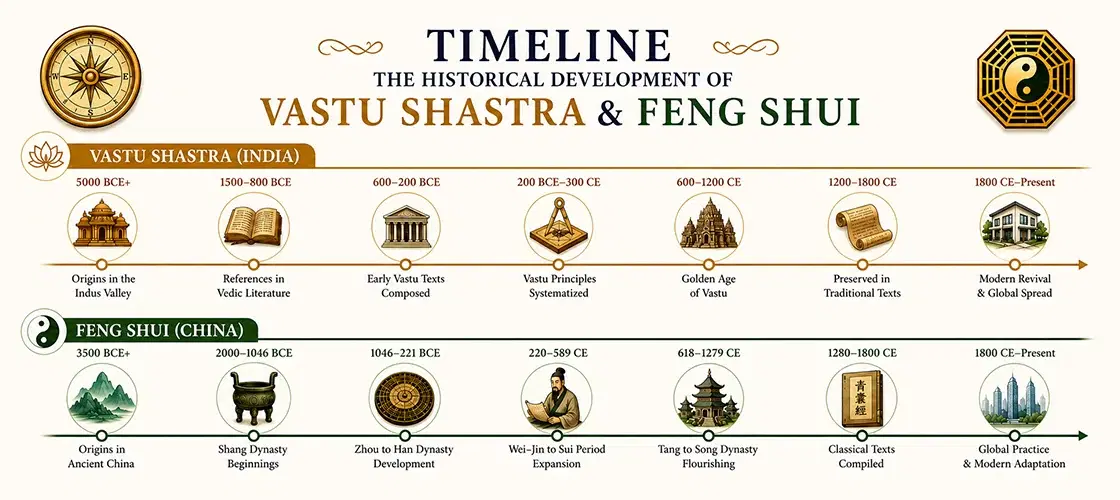
Vastu Shastra is part of the Indian Vedic intellectual tradition. It is one of four Upaveda (secondary Vedic sciences) and belongs specifically to the Sthapatya Veda the Veda of architecture, itself a sub-discipline of the Yajurveda. The earliest references date to roughly 3000 BCE. The most influential classical texts the Manasara, the Mayamata, the Vishwakarma Prakash were compiled between 500 BCE and 500 CE.
Feng Shui (风水, literally "wind-water") emerged from the Chinese geomantic tradition. Its roots are in agricultural observation: where to site a village so it would be sheltered from cold north winds and supplied by flowing water. Early Feng Shui was practical land-use planning. Over the centuries it absorbed Taoist cosmology, the I Ching, and Chinese astrology, becoming the multi-layered system practised today. Major texts include the Zangshu (Book of Burial, 4th century CE) and the Qing Nang Jing.
Both traditions began as architectural disciplines and accumulated energetic and ritual layers over time. Both were originally taught by practitioner-priests, not pure architects or pure mystics. The mix of structural and energetic thinking is a feature of both, not a flaw of either.
Vastu Shastra vs Feng Shui How each system actually works
Vastu Shastra - the practitioner's view
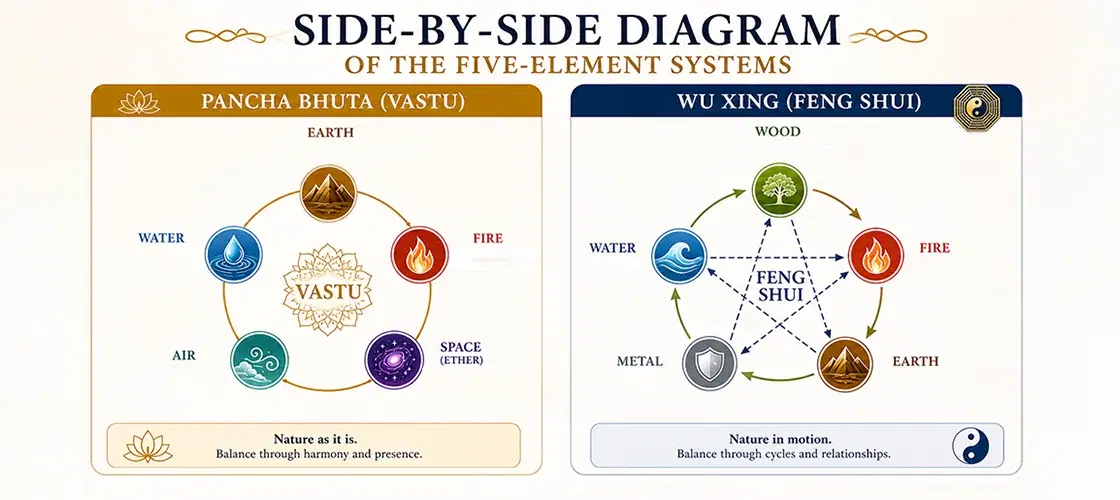
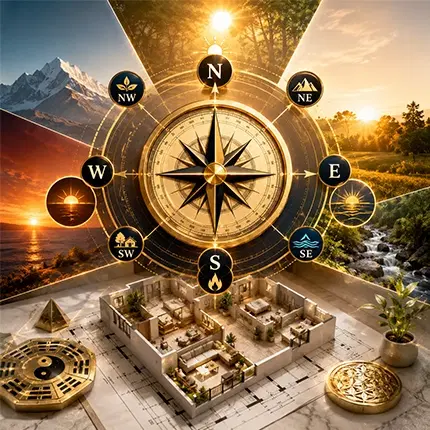
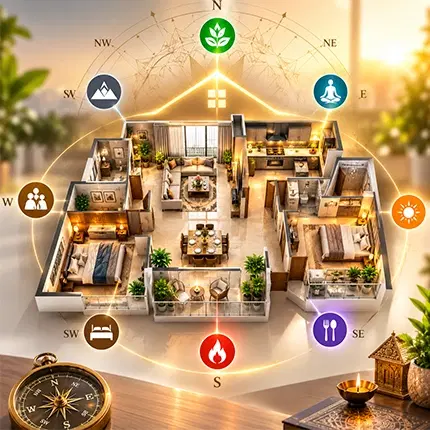
A Vastu reading begins with the floor plan and the property's orientation against the cardinal directions. The practitioner overlays the Vastu Purusha Mandala a square 9×9, 8×8, or 7×7 grid depending on property type onto the plan. Each cell of the Mandala is associated with a deity and an element, drawn from the Pancha Bhuta (earth, water, fire, air, space).
From there, the practitioner identifies which rooms and zones align with their assigned directions and which create defects. The remedy options are structural (move the room) or non-structural (adjust through placement, colour, materials, and symbols). Modern practice including the Layered Vastu method focuses overwhelmingly on the non-structural side.
Feng Shui - the practitioner's view
Feng Shui practice has two main schools. The Form School analyses the surrounding landscape mountains, rivers, roads, neighbouring buildings to understand how external energy (qi/chi) flows toward and around the property. The Compass School (also called Flying Stars in its more advanced form) overlays a directional grid called the Bagua onto the property and identifies the activation level of each zone based on the property's construction date and the current year.
A typical contemporary Feng Shui consultation combines both schools. The practitioner uses a Luo Pan compass (a complex multi-ring instrument) to take precise directional readings, consults a Flying Stars chart for the year, and recommends element placements (wood, fire, earth, metal, water) to balance the activated zones.
Side-by-side comparison
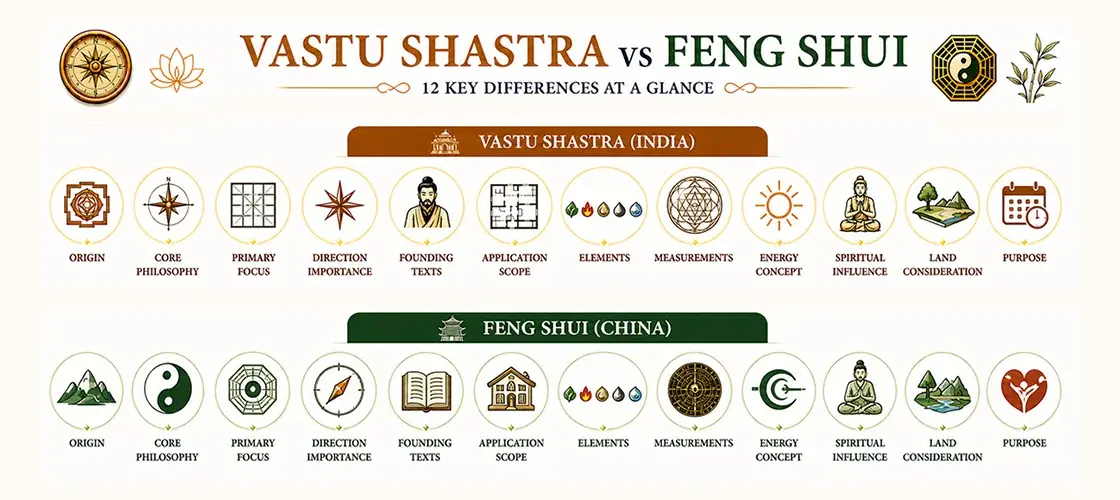 The most useful way to see the Vastu vs Feng Shui differences is in a single table. Twelve dimensions where the two systems either align or diverge:
| Dimension | Vastu Shastra | Feng Shui |
| Origin | India, 5,000 years | China, ~3,500 years |
| Five elements | Earth, water, fire, air, space (Pancha Bhuta) | Wood, fire, earth, metal, water (Wu Xing) |
| Directional system | Eight fixed compass directions, deity-governed | Bagua map (8 zones), oriented to compass or front door |
| Central tool | Vastu Purusha Mandala (grid overlay) | Bagua map + Luo Pan compass |
| Property shape preference | Square or rectangular | More flexible; embraces irregular shapes |
| Time element | Largely static; once corrected, stays corrected | Time-sensitive (Flying Stars updates annually) |
| Major schools | Classical texts (Manasara, Mayamata) broadly unified | Form School + Compass School + Black Hat (modern Western) |
| Practitioner background | Architect + priest hybrid traditionally; modern practitioners often combine architecture and Vedic study | Geomancer + Taoist priest historically; modern practitioners often combine design and astrology |
| Approach to defects | Specific remedies tied to specific Mandala cells | Element rebalancing across the Bagua zones |
| Use of colour | Direction-based (e.g., red in south-east for fire) | Element-based (e.g., red for fire, blue for water) |
| Symbolic objects | Yantras, classical Vedic symbols, religious markers where used | Bagua mirrors, fu dogs, dragons, coins, wind chimes |
| Current cultural fit | Indian properties, Indian diaspora, Hindu/Buddhist/Jain/Sikh contexts | Chinese properties, broader Western adoption, secular contexts |
Read horizontally, you see the systems agree on the importance of orientation, elements, and zoning but disagree on which elements, which directional logic, and which symbols. The disagreements are real but not opposed. They are different vocabularies for closely related observations.
Where they agree?
After a few hundred consultations involving clients who had previously worked with Feng Shui practitioners, certain agreements between the two systems are striking:
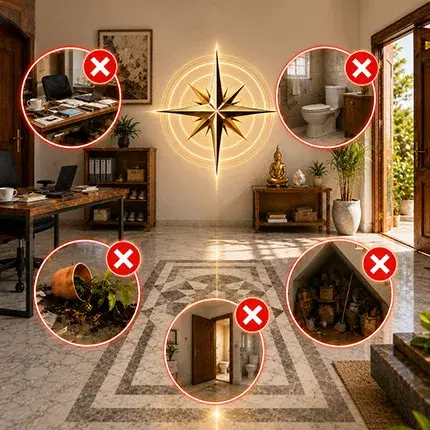
- Bed under a beam. Both systems advise against sleeping directly beneath an overhead structural beam. Both attribute it to compressed energy flow, though the energetic frameworks differ.
- Clutter at the entrance. Both treat the main door as the primary energy channel into the property. Both flag clutter, broken items, or obstructions at the threshold as defects.
- Mirror facing the bed. Both advise against this. The energetic explanations differ slightly Vastu sees it as doubling subconscious activity; Feng Shui sees it as reflecting energy back at sleeping occupants but the practical recommendation is identical.
- Position of the master bedroom. Vastu places it in the south-west; Feng Shui (in most schools) places it in the position farthest from the front door. In most rectangular Indian homes, these end up being the same room.
- Active vs. passive zones. Both systems separate active zones (kitchen, dining, work) from passive zones (bedroom, meditation, rest). The directions assigned differ; the zoning principle is identical.
- Water flow direction. Both treat the direction of water flow (rivers, drains, indoor fountains) as significant. Both broadly favour water flowing toward the front of the property and resist flowing away from it.
- Cluttered storage. Both flag dense storage in sacred zones Vastu in the north-east, Feng Shui in the wealth corner of the Bagua as actively damaging.
When two systems built independently across thousands of miles and thousands of years agree on this many specific points, it suggests both are pointing at something real about how spaces and people interact, even if the mechanisms each describes differ.
Where they disagree?
The disagreements are real and worth understanding before you commit to one system or the other:
The five elements are different. Vastu uses earth, water, fire, air, space. Feng Shui uses wood, fire, earth, metal, water. Three overlap (earth, water, fire), two do not (Vastu has air and space; Feng Shui has wood and metal). The element interactions and remedies built on top of these foundations therefore differ. A "fire imbalance" in Vastu is corrected differently than in Feng Shui.
Directional methodology is different. Vastu uses absolute compass directions: north is always north regardless of which way the front door faces. Feng Shui can use either absolute compass directions (Compass School) or relative directions (the front door is always the bottom of the Bagua, regardless of compass). A property analysed by both schools may receive completely different zone assignments.
Time matters differently. Vastu, once correctly applied, is largely static. The same remedies hold year after year. Feng Shui, particularly in the Flying Stars school, updates annually as the energetic configuration of the property shifts. A Feng Shui consultation typically includes annual updates; a Vastu consultation typically does not.
Practitioner role differs. A Vastu practitioner is often closer to an architect-spiritual-advisor hybrid. A Feng Shui practitioner is often closer to a geomancer-astrologer hybrid. The deliverables of a Vastu consultation tend to be a marked floor plan and a remedy list. The deliverables of a Feng Shui consultation tend to be a Bagua overlay, a Flying Stars chart, and recommended placements.
Use of compass differs in scale. Vastu uses the compass at the broad directional level which side of the property is the north-east, where is the south-west. Feng Shui uses precise compass readings to several decimal places, particularly in the Compass School, because narrow degree differences shift Bagua zone assignments.
Symbolic vocabulary differs. Vastu remedies draw on classical Indian symbology: yantras, copper, brass diyas, and where the client uses them, religious symbols. Feng Shui remedies draw on Chinese symbology: Bagua mirrors, dragons, fu dogs, and metal coins. A Vastu consultant placing a yantra and a Feng Shui consultant placing a Bagua mirror may be solving the same energetic problem with different cultural objects.
Which system fits which client?
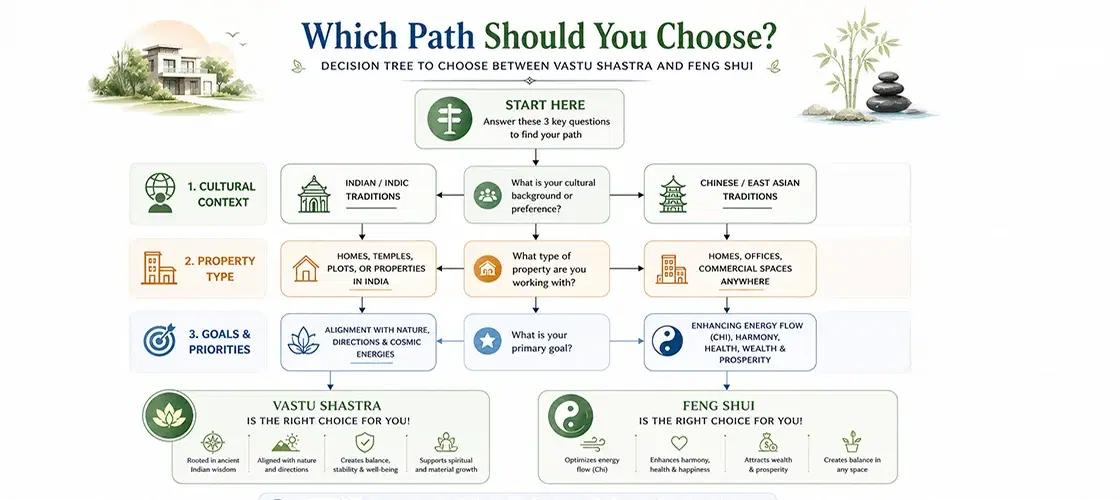
The choice in Vastu vs Feng Shui is rarely about which is 'better'. Both work for the people who apply them. The choice is about cultural fit, practitioner availability, and the kind of work you actually need.
Vastu is usually the better fit when:
- You live in India or come from an Indian family the directional vocabulary will already feel familiar
- Your property is in a Hindu, Sikh, Jain, or Buddhist cultural context where the Vedic frame is natural
- You want a one-time correction that holds, rather than annual updates
- You prefer a practical architectural approach over an astrological one
- You are comfortable with classical Indian symbolic objects (brass, copper, yantras) rather than Chinese ones
- You are starting a business in India and want the consultation to align with how local clients perceive the brand
Feng Shui is usually the better fit when:
- You live in China, Hong Kong, Taiwan, Singapore, or have strong East Asian cultural ties
- You want time-sensitive guidance what to activate or quiet down each year
- You like the granularity of the Flying Stars approach and are willing to update annually
- You are working in design or architecture professionally and want a system already integrated into Western interior design education
- Your property has irregular shapes or unusual landscape features that reward Form School analysis
- You are running a business in a Chinese cultural market or want the consultation to align with how those clients perceive the brand
Either system works when:
- You are interested in the energetic-architectural intersection but have no specific cultural bias
- You are willing to commit to whichever practitioner you can find who is genuinely skilled, regardless of tradition
- Your goal is a single clear correction rather than ongoing optimisation
Can you practise both?
Yes, and many of my international clients do.
The more common path I see is clients who started with Feng Shui in the West, found it useful but felt something was missing, and came to Vastu later. The reverse also happens Indian clients who hear about Feng Shui through interior design culture and want to add its annual updates to their existing Vastu setup.
Practical advice if you want to use both:
- Apply one system fully before adding the other. The two systems use different element vocabularies; mixing them at the same level often produces conflicting recommendations.
- If you already have Vastu corrections in place, treat Feng Shui as a time-sensitive overlay focused on annual energy shifts. Do not re-do the directional work; let Vastu hold that layer.
- If you already have Feng Shui in place, treat Vastu as the structural-architectural reading. Vastu will identify defects in the property's relationship to the cardinal directions that Feng Shui may not flag.
- Avoid practitioners who claim to be expert in both. The frameworks are deep enough that genuine fluency in one usually means working knowledge not expertise in the other. Use a Vastu practitioner for Vastu and a Feng Shui practitioner for Feng Shui.
- Remove conflicting symbols. If a yantra and a Bagua mirror end up in the same wall position, choose one based on which energetic problem you're solving in that location.
How the Layered Vastu method approaches the comparison?
The Layered Vastu method I developed at Layered Vastu https://www.layeredvastu.com/methodology is rooted in classical Vastu Shastra. But it does borrow one specific principle from Feng Shui practice: the willingness to update remedies over time as the client's circumstances change.
Classical Vastu treats a corrected property as corrected. The Layered Vastu method retains that as the default but adds a secondary check: when a client's life situation changes meaningfully (new business, marriage, child, major health event, change of occupants), the personal-alignment layer of the method needs revisiting. The directional remedies hold; the occupant-specific recommendations refresh.
This is not Feng Shui's annual Flying Stars update. It is Vastu adapting to the fact that the people in a space change, and the energy of a space is partly about who lives in it.
For full background on how this works in practice, see
- The Layered Vastu Method https://www.layeredvastu.com/methodology
- the Frequently Asked Questions https://www.layeredvastu.com/frequently-asked-questions
- The Residential Vastu https://www.layeredvastu.com/residential-vastu-expert
- Commercial Vastu https://www.layeredvastu.com/commercial-vastu-expert service pages cover the application.
Conclusion: pick the system, then commit to it
In the Vastu Shastra vs Feng Shui debate, both work for the people who apply them. After 12 years of Vastu practice and a decade of working alongside clients who have used Feng Shui, the most common mistake I see is not the choice between systems it is the failure to commit to either one fully. Half-applied Vastu and half-applied Feng Shui produce roughly the same result: nothing much changes. The energetic premise of both traditions is that consistent, complete intervention shifts something. Tentative application doesn't.
If you live in India or come from an Indian family, start with Vastu. The cultural alignment will help you actually implement the recommendations, which is the part that matters. If you have East Asian cultural ties or want the time-sensitive annual updates, start with Feng Shui. If neither cultural pull is strong, choose based on the practitioner find someone you trust in either tradition and commit to a complete reading.
For Indian and Indian-diaspora clients considering a Vastu consultation, you can reach me on +91 9354096746 or consult@layeredvastu.com. For complete background on how my practice works, see
- The Layered Vastu Method https://www.layeredvastu.com/methodology. For a foundational overview, the pillar guide
- What is Vastu Shastra? https://www.layeredvastu.com/blog/what-is-vastu-shastra-complete-guide covers the basics in depth.
FAQ
Frequently Asked Questions
In the Vastu Shastra vs Feng Shui comparison, both share the premise that physical space affects well-being that physical space affects well-being, but they use different five-element systems, different directional methodologies, and different symbolic vocabularies. Vastu uses earth, water, fire, air, and space, with eight fixed compass directions. Feng Shui uses wood, fire, earth, metal, and water, with the Bagua map oriented either to the compass or the front door. The systems overlap on many specific recommendations but disagree on the underlying framework that produces those recommendations.
Yes, but apply one system fully before introducing the other. The two systems use different element vocabularies and mixing them simultaneously often produces conflicting guidance. The practical sequence is: complete Vastu corrections first to address structural and directional defects, then add Feng Shui as a time-sensitive overlay for annual energy updates. Avoid practitioners who claim equal expertise in both genuine fluency in one usually means working knowledge in the other, not deep expertise.
Feng Shui is more time-flexible because the Flying Stars school updates annually. It is also more shape-flexible Feng Shui handles irregular property shapes more comfortably than Vastu, which prefers square or rectangular plots. However, Vastu is more flexible in remedy implementation: the Layered Vastu non-demolition method handles built-out homes and operating businesses without requiring annual reviews. Each system is flexible in different dimensions, so flexibility alone is not a useful criterion for choosing between them.
Vastu Shastra is older. Its earliest references in Vedic texts date back roughly 5,000 years, with the most influential classical treatises (Manasara, Mayamata, Vishwakarma Prakash) compiled between 500 BCE and 500 CE. Feng Shui dates back roughly 3,500 years, with foundational texts like the Zangshu (Book of Burial) emerging in the 4th century CE. Both traditions absorbed and refined practices over millennia, so age alone does not indicate authority both are mature systems with deep practitioner lineages.
They agree on a surprising amount. Both treat the main door as the primary energy channel. Both flag bed under a beam, mirror facing the bed, and clutter at the entrance as defects. Both separate active and passive zones, both treat water flow direction as significant, and both place the master bedroom in the position farthest from the front door (which in most rectangular Indian homes is the south-west). When two systems built thousands of years apart on different continents agree on this much specifics, both are likely pointing at something real.
Vastu generally remains the better fit for Indian families abroad. The cultural vocabulary, the symbolic objects (brass, copper, yantras), and the directional logic will feel familiar and integrate naturally with how the home is already used. Online Vastu consultations reach Indian diaspora clients across the United States, the United Kingdom, Canada, Australia, and the UAE. Feng Shui remains an option, especially if the property has unusual landscape features that benefit from Form School analysis, but Vastu is usually the more natural starting point.
For Vastu in India, look for practitioners with at least 10 years of practice, documented client outcomes, and a clear methodology. Avoid anyone who recommends demolition as the first answer modern Vastu has non-demolition methods. For Feng Shui internationally, check whether the practitioner specifies which school they work in (Form, Compass, Flying Stars, Black Hat) and ask for recent case examples. In both traditions, the practitioner should give you a written report with specific, reasoned recommendations rather than vague spiritual guidance.
Related Posts














Ready to Transform Your Space?
Get expert Vastu guidance from Seema Bhatia. Start your journey to harmony and prosperity today.