.webp)

Why Vastu matters more for NRI families?
There is a tendency, when families move abroad, to assume that the energy systems behind Vastu Shastra are tied to the Indian subcontinent specifically that the directions don't translate, that the rules don't apply, that the cultural context required to make it work has been left behind in India. None of that is true. The cardinal directions are the cardinal directions. The five elements (earth, water, fire, air, space) are physical universals. The Vastu Purusha Mandala overlays just as cleanly on a home in Edison, New Jersey, as on a home in Greater Kailash. The principles travel with the family because the principles are about physics and human-environment interaction, not Indian geography.
What does change when a family moves abroad is the design language of the homes available. Most Western suburban homes were designed by builders who never heard of Vastu, optimising for street frontage, lot size, and standard layouts that maximise builder margin. The result is that NRI families more often inherit Vastu defects than Indian families do. The doshas are baked into the floor plan before the family ever sees the house.
For diaspora families specifically, Vastu also serves a second purpose beyond the energetic. It is one of the few practical traditions families can actively practise to maintain cultural continuity in a Western context. Children growing up in suburbia who watch their parents place a brass diya in the south-east corner, or who turn the bed because the head was pointing north, learn something about the tradition by living in it. The Vastu changes are small and visible. The cultural transmission is real.
The unique Vastu challenges of Western homes
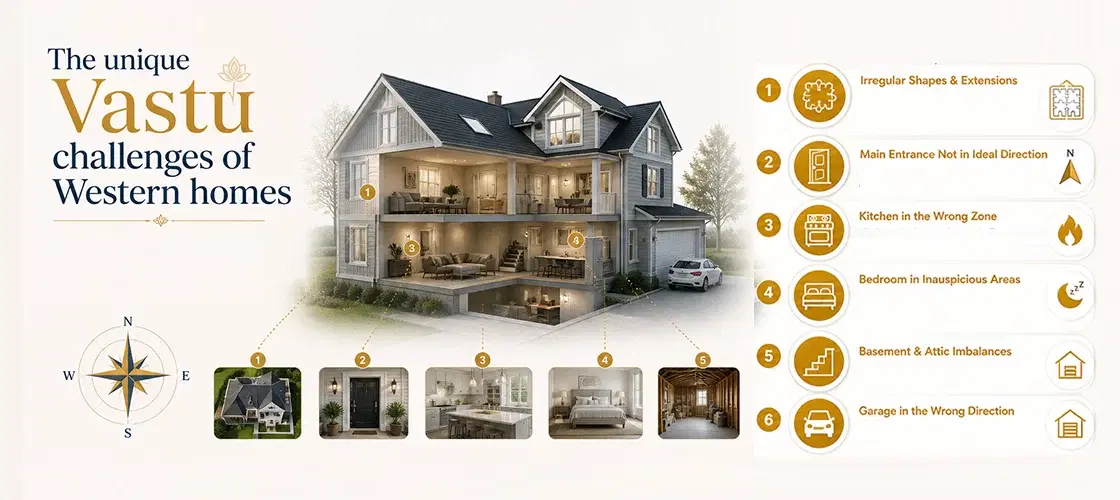
Most Western suburban architecture is built without Vastu consideration. Certain layout patterns recur across US, UK, Canadian, and Australian homes that create predictable Vastu defects:
Basement bedrooms. Many North American homes have finished basements used as bedrooms or guest suites. In Vastu, sleeping below ground level disrupts the elemental balance the earth element overwhelms and creates lethargy and persistent sleep issues. This is one of the most common defects in NRI homes in the US and Canada. Remedy uses specific lighting, colour, and placement strategies to lift the energy of the basement zone.
Attached garages on the wrong side. Western homes often have attached garages on the south, west, or north-west. A garage in the north-east creates the worst defect heavy machinery (cars) and stagnant energy occupying the most sacred zone. North-west attached garages are acceptable for Vastu; south-west is mixed; south or north-east are problems requiring layered remedy.
North-east or south-east kitchens. Kitchen placement in Western homes is determined by builder logic, not Vastu. The north-east kitchen is the most common defect we see it creates direct conflict between fire (the stove) and the water-zone direction. The south-east is technically correct for Vastu but rare in Western suburban builds. Most NRI families need careful balancing in their existing kitchen layout rather than relocation.
Master bedrooms with en-suite bathrooms. A bathroom inside the master bedroom is standard in Western architecture and creates a specific Vastu problem: stagnant water energy adjacent to sleeping energy. The remedy is not to remove the bathroom (impossible) but to apply specific door, colour, and threshold treatments that energetically separate the two zones.
North-facing or south-facing main entrances. Western homes face whatever direction the lot faces. The result is that NRI families often live in south-facing or south-west-facing homes with no choice in the matter. These are not unworkable the Layered Vastu method has specific entrance remedies for every direction but the entrance configuration is one of the things to flag at house-hunting time, not after purchase.
Open-plan living areas. Open kitchen-living-dining floor plans are standard in modern Western homes. Vastu traditionally treats these zones separately. The remedy is to use placement, lighting, and subtle colour zoning to maintain the energetic separation that physical walls would normally provide.
Multi-level homes with offset stairs. Western homes often have a staircase that turns or splits, creating an offset between levels. Vastu prefers continuous staircases on the south or west. The offset stair is a common defect; the remedy uses material substitution and lighting on each landing.
Slab-on-grade construction. In warmer parts of the US, UK, and Australia, homes are built on a concrete slab rather than with a basement or crawl space. This affects how the earth element grounds the property. Specific corner placements compensate.
None of these defects are dealbreakers. Every one has a layered remedy that can be applied within the existing home using locally-sourced materials. But every one of them is something an NRI family should know about before moving in or shortly after.
Country-by-country: the most common Vastu issues we see

The Vastu defects we encounter vary by country because the architectural conventions vary. Here is the pattern from a decade of NRI consultations:
United States. The most common defects are basement bedrooms (especially in the Northeast and Midwest), attached garages on the wrong side (suburban developments rarely orient lots for Vastu), kitchen placement in the north-east or north-west, and en-suite master bathrooms. Open-plan living areas are nearly universal in homes built after 2000 and require specific energetic zoning. Pool placement in the back yard is often south or south-west, which is the wrong direction for water elements.
United Kingdom. Older British homes (Victorian, Edwardian, mid-century) have stronger Vastu compatibility than American suburbs because they were built room-by-room rather than open-plan. The most common defects in UK homes are loft conversions used as bedrooms (sleeping under sloped ceilings), narrow terraced layouts that force the kitchen into the back of the property (often south-east, which is good, but sometimes north-east), and gardens placed in directionally suboptimal positions due to row-house orientation.
Canada. Patterns are similar to the US but the basement bedroom defect is even more pronounced because Canadian winters drive families to use basements year-round. The other distinctive pattern is attached double garages on the front of the house, which often place a heavy machinery zone in the entrance direction. Toronto and Vancouver suburbs in particular show this consistently.
Australia. Australian homes tend to be single-storey or split-level on slab-on-grade construction, which simplifies the directional analysis but creates specific earth-element grounding patterns. The common defects are pool placement (often south or south-west, wrong for water), main entrance facing south or south-west due to lot orientation in newer suburbs, and outdoor BBQ areas placed in the wrong direction (usually relocatable). Sydney and Melbourne suburbs show these patterns consistently.
UAE (Dubai, Abu Dhabi, Sharjah). Apartment living dominates, and the Vastu issues are different from house-based properties. Common defects are kitchens that share a wall with the master bedroom (water-fire-bedroom conflict), main entrance opening into the living area without a defined foyer, and maid's rooms placed in directional zones that disrupt the household. UAE properties are often easier to remediate because apartment living concentrates the directional problems into fewer cells.
The NRI lifecycle: when Vastu typically becomes important
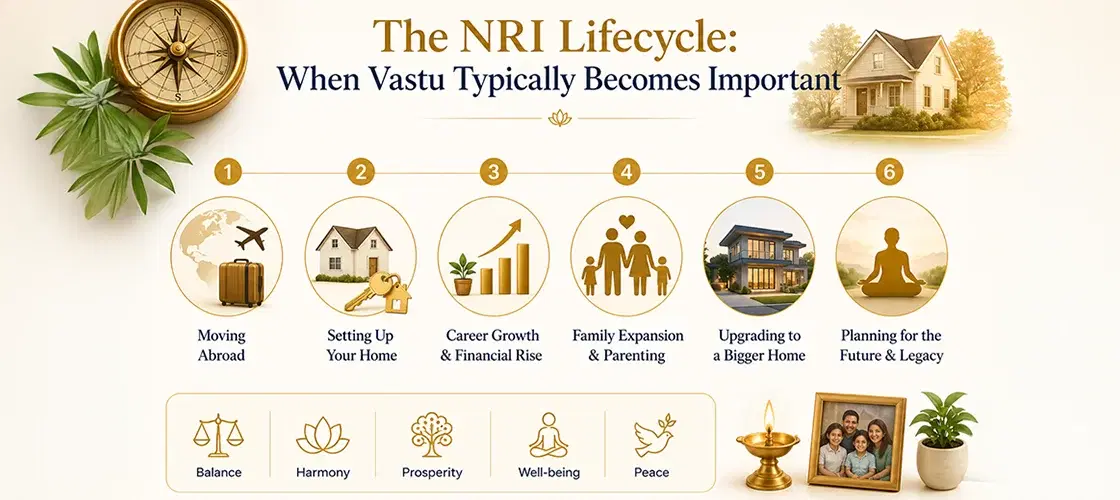
Across nine years of NRI consultations, certain life events consistently bring families to Vastu. Knowing the pattern helps you decide whether a consultation is timely for you:
Buying the first home abroad. The single most common trigger. Families who would not have thought about Vastu in a rental apartment suddenly want it considered when they are about to commit to a 30-year mortgage. A pre-purchase Vastu consultation can be done from a property listing's photos and floor plan in under a week and may flag issues that change the buying decision.
Persistent sleep or health issues that have no medical explanation. Families who have ruled out the obvious medical and stress-related causes sometimes wonder whether something about the home itself is the problem. Vastu reading often identifies specific bedroom or sleep-direction defects that, when corrected, produce a reportable difference in 4–8 weeks.
Birth of a child. A common trigger for second-generation Indian-origin parents who want to bring traditional practices into the home for the first time. The consultation typically covers the nursery, the parents' bedroom, and the household's elemental balance overall.
Starting a business or working from home permanently. After Covid, many NRI professionals shifted to permanent work-from-home or started small businesses from a home office. Suddenly the home office direction, desk orientation, and screen position all matter at the level they would in a commercial space.
Persistent financial or career stagnation. When a family has been in a property for 3–5 years and cash flow, career growth, or business expansion has stalled despite their best efforts, Vastu sometimes identifies specific directional issues that have been quietly working against them.
Planning a return to India or a Vastu Consultant for NRI Property Purchase. NRI families planning to move back to India often want Vastu guidance on the Indian property they are about to buy or build. This is usually a much easier consultation than the foreign property Indian builders increasingly understand Vastu, and remedy options are wider.
Pre-marriage or post-marriage relocation. When two families merge into one home whether through marriage, parents joining adult children, or family reunification the directional and personal-alignment layers shift. A reading helps the new household configuration land cleanly.
How Vastu integrates with Western architectural realities
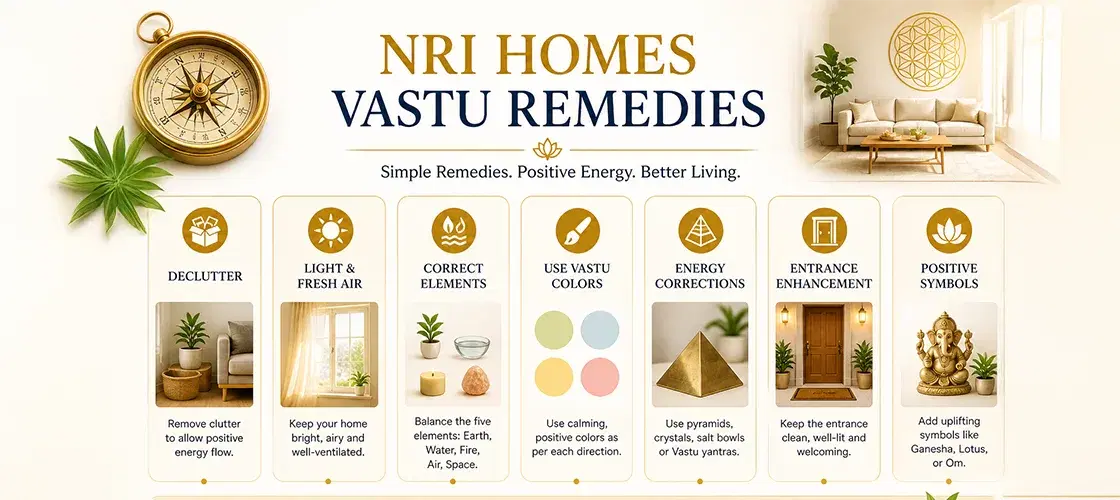
A common worry NRI clients have before booking a consultation: "What if everything in my house is wrong?" The answer, after thousands of NRI readings, is that Western homes are rarely "everything wrong." There are typically several specific things wrong, with everything else either neutral or workable. The Layered Vastu method is built on the assumption that you cannot relocate rooms, demolish walls, or restructure the property. The remedies use placement, colour, materials, symbolic objects, and personal alignment to address each defect through movable adjustments. This is the same method used for Indian rental flats and operating commercial premises, the same philosophy that makes it the only practical and Best Vastu Expert for NRI families.
For most Vastu Shastra Consultation for NRI Homes, a typical reading produces 12–20 specific recommendations. Of these, roughly a third are no-cost rearrangements (turn the bed, move the desk, swap a cushion colour), a third are low-cost additions under $50 (a brass diya, a yantra, a specific plant), and a third are moderate adjustments that may require small purchases or minor decor changes. Most NRI clients implement the priority recommendations within 2–3 weeks of receiving the report and the remaining recommendations over the following 4–8 weeks. Reportable changes in sleep, household tone, or financial movement typically appear in the 4–12 week window after the highest-priority remedies are in place.
Cultural continuity: passing Vastu to the next generation
A theme that comes up in almost every NRI consultation, often unprompted, is the role Vastu plays in keeping Indian cultural practice alive in homes where children are growing up primarily in a Western context. For first-generation NRI parents, Vastu is often a tradition they grew up watching their parents and grandparents practise without thinking about it. For second-generation children in suburbia, that osmotic transmission is harder. The grandparents are not in the next room. The temple is not down the street. The cultural defaults of the surrounding society don't reinforce Vastu the way they would in India.
What Vastu provides is a set of small, visible household practices that children can learn by watching. Why we sleep with our heads pointing south. Why the brass diya goes in the south-east of the kitchen. Why the front door has a specific colour and a specific threshold treatment. The kids may not retain the technical reasons. They will retain that this is what their family does, that there is a logic to it, and that it connects them to something older than the suburb they live in. A few NRI clients have, over the years, asked me to make the consultation deliberately second-generation-friendly: explanations the kids can follow, recommendations the family can implement together, a written report the children can read. I always agree. Vastu transmission across generations is part of the work.
How a typical NRI consultation works?
For practical details on the Online Vastu Consultation for NRIs format, what you share before the session, what happens during, what you receive afterward, and how NRI Home Vastu Analysis and Remedies works in your country, see the dedicated guide for NRI Vastu Consultation Services How It Works https://www.layeredvastu.com/blog/online-vastu-consultation-how-it-works.
In short: you share your floor plan, photographs of every room, photographs of the property exterior, and birth details for all primary occupants. I review everything in advance. We meet over Zoom or Google Meet for 60–90 minutes. I will send a written report with a marked floor plan and prioritised remedies within 3–5 working days.
Time zones are accommodated to suit you. Most US clients book mornings in India (their evenings); UK and European clients book afternoons in India (their mid-day); Australian clients book late afternoons in India (their early evenings); UAE clients have the easiest overlap with regular Indian business hours.
Booking a consultation from abroad
If you are an NRI family in the US, UK, Canada, Australia, UAE, or anywhere else outside India, the easiest first step is a brief WhatsApp message at +91 9354096746. Tell me where you are, what kind of property you're in, and what brought you here today. There is no commitment until you decide the consultation is right for you.
To Book Online Vastu Consultation for Overseas Indians, you can also email consult@layeredvastu.com or use the contact form at layeredvastu.com/contact-us. WhatsApp is usually fastest; most NRI clients book that way because the response time is short and the timezone gap is easy to work around.
For background reading before the consultation
- What is Vastu Shastra? https://www.layeredvastu.com/blog/what-is-vastu-shastra-complete-guide Covers the core principles and foundational concepts of Vastu Shastra in detail.
- Vastu vs Feng Shui: Differences & Similarities https://www.layeredvastu.com/blog/vastu-vs-feng-shui-differences-similarities Helps clients understand the key differences and similarities between both practices.
- Online Vastu Consultation: How It Works https://www.layeredvastu.com/blog/online-vastu-consultation-how-it-works Explains the complete process and practical steps of an online consultation.
Service-Specific Information
- Residential Vastu https://www.layeredvastu.com/residential-vastu-expert
- Commercial Vastu https://www.layeredvastu.com/commercial-vastu-expert
- Industrial Vastu https://www.layeredvastu.com/industrial-vastu-expert
- Numerology https://www.layeredvastu.com/numerology
- Scientific Logo Design https://www.layeredvastu.com/scientific-logo-design
FAQ
Frequently Asked Questions
Yes, fully. The cardinal directions, the five elements, and the Vastu Purusha Mandala are all physical universals they overlay just as cleanly on a home in New Jersey or Manchester as on a home in New Delhi. What changes abroad is the design language of available homes. Western architecture rarely considers Vastu, so NRI families more often inherit Vastu defects than Indian families do. The principles travel; the building conventions don't. The Layered Vastu method addresses that gap directly.
Not at all most NRI clients are in exactly that situation. The Layered Vastu method is specifically designed for already-built homes where structural change is not an option. Defects in the layout (basement bedroom, north-east kitchen, attached garage) are addressed through movable remedies: placement, colour, materials, and symbolic objects. Across a typical NRI consultation, 100% of the recommendations can be implemented without demolition or major construction. Twelve-year-old homes get the same effective treatment as new builds.
In our consultations across the US specifically, basement bedrooms and attached garages in the wrong direction are the two most common defects. Basement bedrooms create earth-element imbalance and are linked to persistent sleep and energy issues. Attached garages, depending on which side of the house they sit, can disrupt either the wealth zone (north-east) or the entrance flow (south or west). Both have specific layered remedies that can be applied within an existing home using locally-available materials.
Yes, and pre-purchase Vastu consultations are some of the most valuable readings I do. From the listing photos and floor plan, I can identify the major directional and zonal issues before you commit. This sometimes changes the buying decision and even when it doesn't, you go in knowing what you'll need to remediate after closing. The consultation typically takes 3–5 days, which fits within most home-buying timelines if you start at the offer stage.
Almost never. Most Vastu remedies are decorative or functional adjustments that read as normal interior choices to anyone who isn't specifically looking for them. A brass diya in a corner, a specific paint colour, the placement of a side table, the orientation of a desk these don't announce themselves. The few items that are explicitly cultural (yantras, religious symbols) are typically placed in private areas of the home where guests don't go. NRI families rarely report any social awkwardness from Vastu changes.
Most basics are available locally. Indian grocery stores in major metros carry brass diyas, copper items, and standard puja supplies. Amazon in your country reliably stocks yantras and decorative Vastu objects. For each recommendation in the report, I include specific sourcing notes typical Indian name, English name, where to find it locally, and online alternatives when local sourcing is hard. Clients in smaller cities sometimes order online, which I help navigate. Sourcing has rarely been a serious barrier.
Time zones are scheduled to suit you. Mornings in India work well for US clients (evenings for them); afternoons in India work for UK and Europe; late afternoons in India work for Australian clients; UAE has easy overlap with Indian business hours. Consultations are conducted in English or Hindi based on your preference, with bilingual reports available at no extra cost. For mixed households (one Hindi-speaker, one English-speaker), we typically run the session in English with Hindi clarification where helpful.
Related Posts










Ready to Transform Your Space?
Get expert Vastu guidance from Seema Bhatia. Start your journey to harmony and prosperity today.